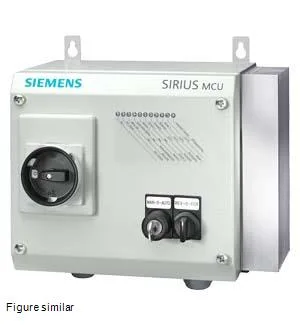
Solid-state reversing starter with AS-Interface
The Siemens 3RK4320-5DQ64-1BA2 is a SIRIUS reversing motor starter built around solid-state switching contacts and solid-state motor protection. Unlike a conventional electromechanical reversing contactor pair, this unit has no moving contacts to arc or weld — the semiconductor output handles the direction reversal internally. It communicates over AS-Interface (the protocol is supported per the spec), so it lands as a fieldbus slice on an AS-i network. Two onboard digital inputs let the starter accept local control signals without an additional I/O block.
Supply and control voltage envelope
The main circuit operates on 340...460 V AC at 50 or 60 Hz, 3-pole. The control supply is 20.4...26.4 V DC — a standard 24 VDC panel rail works, but the 20.4 V floor means the starter stays operational during a moderate brownout on the control bus. IP54 protection means the housing is dust-protected and splash-resistant — suitable for cabinet mounting, not direct washdown. This gives flexibility for tight panel layouts where the starter must sit at an angle to clear gland plates or busbars.
Dimensions and panel fit
The enclosure measures 205 mm deep by 290 mm wide by 215 mm high. That footprint is larger than a typical IEC reversing contactor pair because the solid-state power stage and AS-Interface electronics are integrated into one housing. Plan for this when laying out the backplate — the 290 mm width may span two DIN-rail sections if mounted side-by-side with other starters.
Cycling and protection coordination
The starter is rated for 3600 operating cycles per hour — that is one start-reverse-stop every second. The solid-state output handles this without the mechanical fatigue that limits an electromechanical contactor's life at high cycling rates. Short-circuit protection is designed for use with circuit-breakers upstream, not fuses. The unit includes a motor brake output component (24 V DC brake control is not present, but the brake output provision is built into the design). For applications requiring a holding brake, this saves an external brake rectifier or relay.