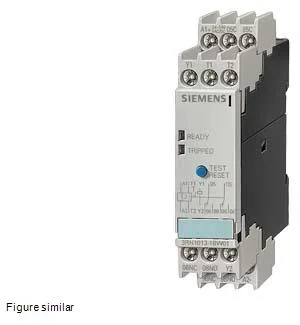
The Siemens 3RN1013-1BW10 is a thermistor motor protection evaluation unit from the SIRIUS 3RN1 family. It monitors PTC thermistor sensors embedded in motor windings and trips the control circuit when the winding temperature exceeds the sensor's rated response threshold, protecting the motor from overheating under overload or stalled-rotor conditions. This simplifies panel wiring and reduces component count for machines shipped to multiple regions. The unit provides two changeover (CO) contacts for auxiliary signaling — enough to drive a PLC input and a local alarm lamp simultaneously. There are no dedicated NC or NO contacts; both are CO, giving flexibility for fail-safe or normal-open logic.
Housing is 22.5 mm wide, 102 mm tall, 91 mm deep — the standard single-module width for DIN-rail enclosures.
Lifecycle reality and sourcing posture
The 3RN1013-1BW10 is marked as a phased-out product. The preferred successor is the 3RN2013-1BW30, which offers the same thermistor motor protection function with multifunctional evaluation, also at 24-240 V AC/DC, and with safe isolation.
Key functional feature: reclosing lockout
The unit includes a reclosing lockout function, which prevents automatic restart after a motor trip until the fault is manually acknowledged or the supply is cycled. This is critical for unattended machinery where an automatic restart after a thermal trip could cause injury or equipment damage. An LED on the front provides local status indication of the trip condition, aiding quick fault diagnosis during commissioning or maintenance without needing a handheld tool.