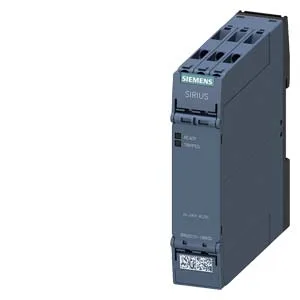
The Siemens 3RN2010-1BW30 is a SIRIUS 3RN2 thermistor motor protection relay — a standard evaluation unit designed for use with PTC thermistor sensors (bimetallic switches) embedded in motor windings. It monitors motor temperature directly, not just current, so it catches an overheating condition before the winding insulation degrades. The relay accepts a supply voltage of 24 to 240 VAC/DC at 50/60 Hz, making it suitable for global control voltages without a separate transformer. Its output switches up to 1 A at 24 V, 0.2 A at 125 V, or 0.1 A at 250 V — enough to drive a contactor coil or PLC input directly. Auto-reset is enabled by default, so the relay automatically resets when the motor cools below the PTC threshold. If your application requires a manual reset latch to prevent automatic restart after a thermal trip, this unit does not support an external reset input — you would need a variant with that feature.
The housing is 22.5 mm wide, 100 mm tall, and 90 mm deep — a standard single-module width that snaps onto 35 mm DIN rail (screw and snap-on mounting). Clearance around the relay: zero mm required upwards, forwards, backwards, downwards, or at the side — it can be butted directly against adjacent devices without derating. This is unusual for a relay and simplifies panel layout. Terminals accept solid or stranded wire from 20 to 12 AWG (1x 20-12, 2x 20-14 for solid). The IP20 finger-safe housing protects personnel during maintenance but is not rated for washdown environments.
Thermal protection logic and precision
The relay triggers a trip when the PTC sensor resistance exceeds the response threshold (initial value 0.85 kΩ, full-scale value 1.1 kΩ). The relative metering precision is 9 %, which means the trip point is repeatable within that band — adequate for motor protection where the thermal time constant is minutes, not seconds. An LED on the front provides local status indication. The relay has no error memory — after a trip and cool-down, it resets automatically (auto-reset enabled) without retaining a fault history. For applications that need a latched alarm, plan for an external memory or a different relay variant. Galvanic isolation exists between input and output, and between the outputs themselves, so the relay can switch a separate control circuit without coupling noise back to the sensor wiring.