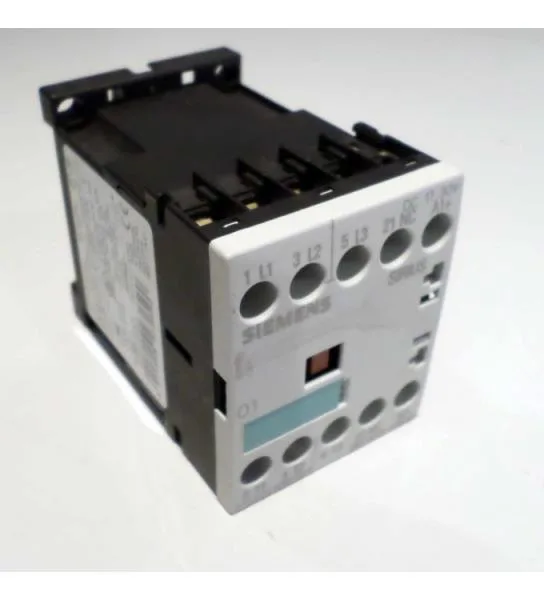
Its 10 A rated operational current at 24 V (AC-3 duty) means it can handle small induction motors up to that current — think conveyors, pumps, or fan starters in a 24 V control scheme. Side-by-side mounting is supported, so you can gang multiple units without spacing.
The 10 A at 24 V (AC-3) is the headline motor-switching rating. For resistive loads (AC-1), the contactor carries 6 A at 230 V and 3 A at 400 V — useful if you are switching heaters or lighting banks off the same device. At higher voltages, the AC-3 motor power rating is 3.5 kW at 500 V and 4 kW at 690 V. This tells you the contactor can drive a 4 kW motor on a 690 V line, but the 24 V coil means the control circuit is low-voltage — common in PLC-driven panels where the 24 VDC supply is already present. For DC switching, the contactor handles 10 A at 24 V, 2 A at 60 V, 1 A at 110 V, and 0.3 A at 220 V. These are the make/break limits for DC loads — note the steep derating as voltage climbs, which is typical for DC arcs. The AC-4 rating (6.5 A at 400 V) covers inching or plugging duty where the contactor opens under full motor current — if your application requires frequent reversing or jogging, the AC-4 figure governs contact life.
The contactor carries screw-type terminals for both main and auxiliary circuits, accepting conductors from 0.5 mm² up to 4 mm² (or 20–12 AWG). Terminal capacity is stated for solid and stranded wire; the maximum is 2x 4 mm² per clamp, which covers most panel wiring up to a 4 kW motor feed.