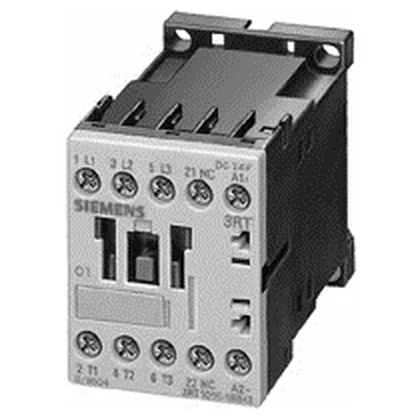
Rated for AC-3 duty, it handles motor loads up to 4 kW at 690 V and 3.5 kW at 500 V.
The AC-3 motor power ratings — 4 kW at 690 V, 3.5 kW at 500 V — are the headline numbers for sizing. That's the load the contactor can switch under full running current. The AC-4 rating of 6.5 A at 400 V matters if the contactor sees plugging or jogging duty. AC-4 is the harsher switching condition — making and breaking at locked-rotor current — so it's the limiting factor for applications with frequent reversals. Auxiliary contact ratings: 10 A at 24 V, 6 A at 230 V, 3 A at 400 V, 0.3 A at 220 V DC. That DC rating is low — typical for a contactor this size — so if you're switching a DC control circuit at 220 V, verify the load current stays under 0.3 A. That's the mechanism, not the electrical contacts — actual electrical life depends on switching current and load type, but the mechanical figure gives a sense of the actuator durability.
Screw terminals on the main circuit accept 2x (0.5 to 1.5 mm²), 2x (0.75 to 2.5 mm²), or up to 2x (0.75 to 4 mm²) solid or stranded. AWG equivalents are 2x (20 to 16), 2x (18 to 14), and 1x 12. That covers most panel wiring up to 4 mm² without needing ferrules, though ferruled stranded is preferred for reliability. Maximum operating altitude is 2000 m — above that, derate for air density.
No official successor has been announced, which is typical for an active-line part. If you're cross-referencing a panel built around a different SIRIUS size S00 contactor, the footprint and terminal layout are consistent across the family, but verify the coil voltage and rating against your load.