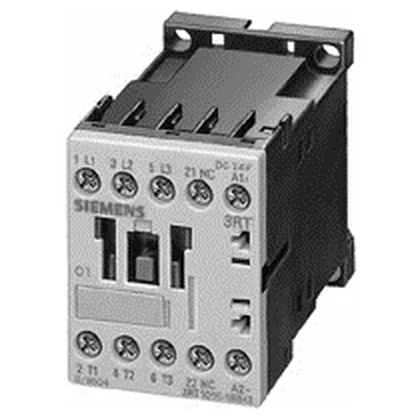
It carries a 110 V 50 Hz / 120 V 60 Hz coil and provides a rated operating current of 10 A in AC-12 duty, which means it handles resistive and transformer loads up to that current. For motor switching, it is rated 3 kW at 400 V in AC-2 duty (slip-ring motors) and 6.5 A at 400 V in AC-4 duty (plugging/inching).
The coil tolerance spans 0.85 to 1.1 times rated voltage at 50 Hz and 0.8 to 1.1 at 60 Hz — so at 110 V 50 Hz, the coil picks up reliably down to about 93.5 V and holds in up to 121 V. That's a wider dropout margin than some older contactors, useful if your control transformer sags under inrush. The main circuit uses screw-type terminals accepting 2x (0.5 to 1.5 mm²) solid or 2x (0.75 to 2.5 mm²) stranded, with a maximum of 2x 4 mm². For AWG, that's 2x (20 to 16) solid or 2x (18 to 14) stranded. The auxiliary contact block provides 1 normally-open instantaneous contact rated 10 A at 24 V, 6 A at 230 V, and 3 A at 400 V — enough for a PLC input or a holding circuit interlock.
The front of the device and the terminals are rated IP20 — finger-safe but not protected against moisture, so it belongs inside a panel rated IP54 or better.
For short-circuit protection, the manufacturer specifies two coordination types. With Type 2 coordination (contactor remains suitable for further service after a fault), use a gL/gG fuse rated up to 20 A. These fuse ratings assume the contactor is paired with an appropriate overload relay — the contactor itself does not have integral overload protection.