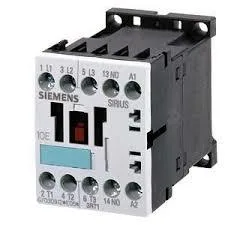
The Siemens 3RT1015-1AK62-1AA0 is a SIRIUS power contactor in the Size S00 frame — the smallest footprint in the SIRIUS family, 45 mm wide and 72 mm deep, designed for screw and snap-on mounting onto 35 mm DIN rail per DIN EN 50022. Rated for a 24 VDC coil, it pulls in at 0.85 to 1.1 times rated voltage at 50 Hz and 0.8 to 1.1 at 60 Hz — standard pick-up margins for industrial control circuits. This is a current-production part — no obsolescence flag, no last-time-buy clock ticking.
Motor duty and switching capacity
For motor loads, the 3RT1015-1AK62-1AA0 is rated 3 kW at AC-2 duty at 400 V — that's the category for slip-ring motor starting, where the contactor sees moderate inrush and makes/breaks under load. At AC-4 duty (plugging, inching, reversing) at 400 V, it handles 6.5 A, which covers smaller reversing drives or frequent jogging applications. At 690 V it's rated 4 kW, so it can switch loads on 690 V three-phase systems common in heavy industrial plants. The AC-12 rating at 10 A maximum covers resistive and solid-state loads in control circuits. Compared to the physically larger 3RT1016-1AG61 (also Size S00 but with a different coil voltage and higher current rating), this 3RT1015-1AK62-1AA0 with its 24 VDC coil and 10 A at 24 V rating is the right pick when your control voltage is 24 VDC and the load doesn't exceed the AC-4 6.5 A ceiling. The 3RT1016 siblings are higher-current variants; this one is the mid-range workhorse for standard 24 VDC panels.
These are the values your panel designer needs for the SCCR calculation and for selecting the upstream protective device.
Main current circuit terminals are screw-type, accepting 2x (0.5 to 1.5 mm²), 2x (0.75 to 2.5 mm²), or up to 2x (0.75 to 4 mm²) solid or stranded conductors. AWG equivalents are 2x (20 to 16), 2x (18 to 14), and 1x 12. That covers standard panel wiring up to 4 mm² — enough for the 10 A rated current at 24 V. The IP20 terminal protection means the screw terminals are touch-safe from the front after wiring.