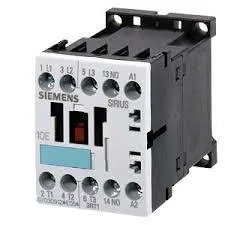
Rated for AC-2 duty at 3 kW on a 400 V supply, this contactor handles slip-ring motor starting and reversing. The AC-4 rating of 6.5 A at 400 V covers plugging and inching duty cycles, while the AC-12 rating of 10 A covers resistive loads like heaters. The IP20 front protection means it's suited for enclosed panel use where tools or fingers won't contact live parts during operation.
The ZW97 suffix indicates a special version — likely a customer-specific variant or a non-standard packaging. Confirm with your Siemens contact that the standard 3RT1015-1AP01 (without suffix) is a drop-in replacement if the ZW97 features aren't required for your application.
Main circuit connections use screw-type terminals accepting 2x (0.5 to 1.5 mm²), 2x (0.75 to 2.5 mm²), or a maximum of 2x (0.75 to 4 mm²) solid or stranded conductors. AWG equivalents are 2x (20 to 16), 2x (18 to 14), or 1x 12. The depth of 72 mm leaves room for wiring ducts in the panel. For short-circuit coordination, a Type 2 assignment requires a gL/gG fuse rated 20 A, while Type 1 coordination allows up to 35 A. Side-by-side mounting is supported without derating, which simplifies multi-contactor groups.
Environmental limits and endurance
At 50 Hz the coil operates at 0.8 to 1.1 times rated voltage; at 60 Hz the range is 0.85 to 1.1. This gives a wider pickup tolerance at 50 Hz, useful if line voltage sags are common.