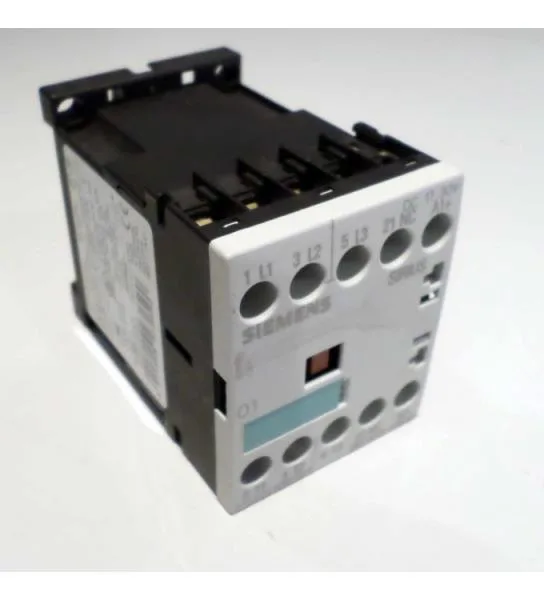
The coil draws 3.3 W both on pick-up and hold, so the control transformer or DC supply must be sized for continuous 3.3 W draw per contactor. The AC-3 motor-switching capability at 400 V is 3 kW, which covers a standard 4-pole induction motor up to that output; the AC-4 reversing duty rating at 400 V is 6.5 A, meaning frequent jogging or plugging stays within the contactor's thermal limits. For resistive loads (AC-12), the maximum operating current is 10 A. The IP20 finger-safe terminals and front keep live parts protected inside the enclosure, but the contactor itself is not rated for washdown — it belongs in a panel or junction box.
Switching capacity across voltages
The contactor's switching ratings vary by voltage and duty. For DC-13 solenoid loads: 10 A at 24 V, 2 A at 60 V, 1 A at 110 V, 0.3 A at 220 V. For AC-2 slip-ring motor duty at 400 V: 3 kW. For AC-3 squirrel-cage motor duty: 3.5 kW at 500 V, 4 kW at 690 V. For AC-4 reversing duty at 400 V: 6.5 A. The pickup voltage threshold is 0.85 × rated (about 35.7 VDC), and the dropout is 1.1 × rated (about 46.2 VDC) — so a supply dipping below 35.7 V may fail to close the contactor.
Terminal wiring and short-circuit protection
Main current circuit terminals are screw-type, accepting 2 × (0.5 to 1.5 mm²) solid, 2 × (0.75 to 2.5 mm²) stranded, or max 2 × (0.75 to 4 mm²) fine-stranded. AWG equivalents: 2 × (20 to 16), 2 × (18 to 14), and 1 × 12. Type 1 coordination allows a 35 A gL/gG fuse. The degree of pollution is 3 (conductive pollution), so the contactor is suited for industrial environments with occasional condensation.