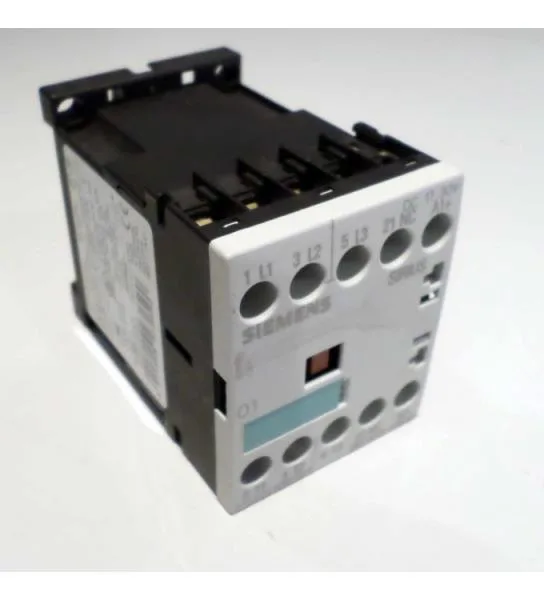
Siemens 3RT1015-1VB41 — SIRIUS Power Contactor, 24 V DC Coil, Size S00
It carries a 24 V DC magnet coil with an integrated diode surge suppressor — the holding power is a steady 1.4 W, so the coil driver sees a constant load whether the contactor is pulling in or sealed. Rated for AC-3 duty at 400 V, it handles 3 kW motor loads (6.5 A at AC-4 for reversing or plugging duty). The main contacts are rated 10 A at 24 V for DC switching, 6 A at 230 V AC, and 3 A at 400 V AC. For resistive AC-1 loads the maximum operating current is 10 A. Screw-type terminals accept 2x (0.5…1.5 mm²) solid or stranded, up to 2x (0.75…4 mm²) max.
Switching Ratings and Coordination
The 3RT1015-1VB41 covers a broad voltage range across AC and DC loads. At 60 V DC it switches 2 A; at 110 V DC, 1 A; at 220 V DC, 0.3 A. For AC motor loads at 500 V it is rated 3.5 kW, and at 690 V, 4 kW. The DC ratings are particularly useful for switching solenoids or DC brake coils in the same panel. Fuse coordination is specified: Type 2 coordination requires a gL/gG 20 A fuse; Type 1 coordination allows a 35 A gL/gG fuse. This matters when the contactor is part of a coordinated starter assembly — the fuse size determines whether the contactor survives a short circuit.
The closest functional peer within the same Size S00 frame is the 3RT1015-1BB42, which differs primarily in coil voltage (24 V AC, 50/60 Hz) and lacks the integrated diode suppression. The 3RT1015-1VB41 with its 24 V DC coil and built-in diode is the correct choice for DC control systems; swapping to the AC coil variant would require adding an external rectifier or changing the control transformer.
The 72 mm depth leaves clearance for wiring ducts and terminal blocks behind the contactor. Screw terminals accept AWG 20–14 solid or stranded (2x conductors), with a maximum of 1x AWG 12 per terminal. The integrated diode surge suppressor means no external flyback diode is needed across the coil — saves one component and one wiring step per contactor. Verify polarity: the diode is reverse-biased when the coil is energized, so incorrect polarity will short the power supply through the diode.