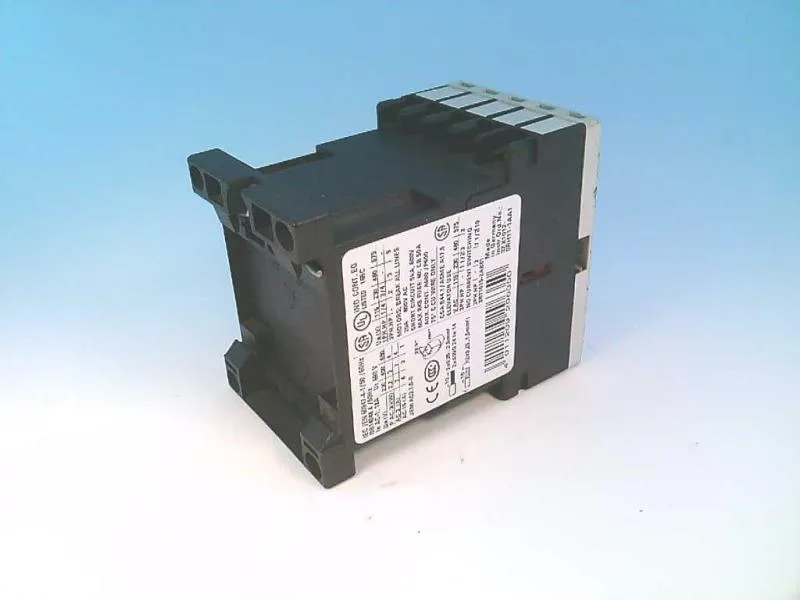
It's rated for a 24 V 50/60 Hz coil, pulling in at 0.8 to 1.1 times rated voltage at 50 Hz and 0.85 to 1.1 at 60 Hz. The main contacts are spring-loaded terminals, accepting 2x (0.25 to 2.5 mm²) solid or stranded wire, or 2x (24 to 14 AWG).
The contactor's switching capacity is defined by duty class. At AC-2 (slip-ring motor starting) at 400 V, it's rated for 3 kW. At AC-4 (plugging/inching) at 400 V, it handles 6.5 A. For resistive loads at 24 V, it's rated 10 A; at 230 V, 6 A; at 400 V, 3 A. Short-circuit coordination is specified: type 2 coordination requires a gL/gG fuse rated 20 A; type 1 coordination requires 35 A. This means the contactor can clear a fault without damage to the contactor itself (type 2) or with acceptable damage (type 1), depending on the upstream protection you select.
Width is 45 mm, height 60 mm, depth 73 mm — a compact footprint that fits a standard DIN-rail enclosure.
The contactor carries a substance prohibition date of 01.07.2006, indicating RoHS compliance from that date. The IEC 81346-2 reference code is Q, which designates it as a switching device in a power circuit. No UL or CSA listing is explicitly stated in the evidence, but the SIRIUS line typically carries these for the North American market — verify the specific nameplate marking if UL listing is required for your jurisdiction.