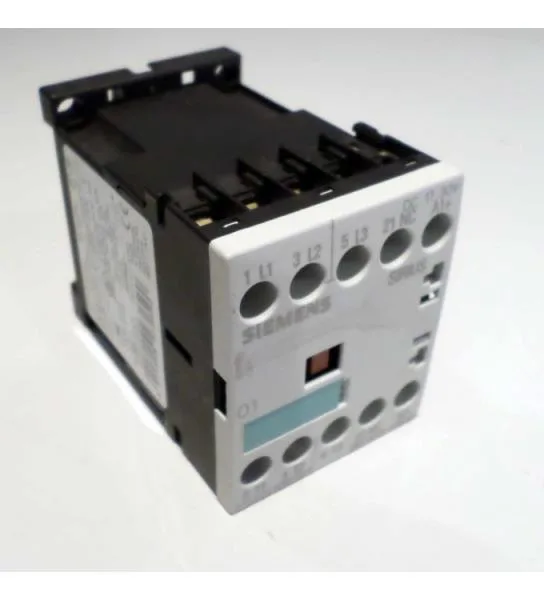
The spring-loaded terminals accept 2x (0.25 to 2.5 mm²) solid or stranded wire, so termination is vibration-resistant and fast to commission.
The S00 footprint — 45 mm wide, 60 mm tall, 73 mm deep — fits standard panel layouts and leaves room for side-by-side mounting without derating, as the side-by-side mounting flag is set. The IP20 finger-safe terminal shroud on the front and at the terminals means it can sit on a live panel rail without additional guarding, though pollution degree 3 (conductive or dry non-conductive pollution) is the rated environment.
The headline 10 A at AC-12 is the resistive-load rating — the current the contactor can make and break with a power factor near unity. For motor loads, the AC-3 rating (not explicitly listed in this extract) typically governs, but the AC-2 rating at 400 V is 3 kW, and AC-4 at 400 V is 6.5 A, which tells you the contactor handles reversing or inching duty cycles where the motor is switched under load. The coil hold-in is lower, but the pick-up surge is what you size the control circuit for. Short-circuit coordination is specified: with type 2 coordination (minimal damage to the contactor after a fault), a gL/gG fuse rated 20 A is required; type 1 coordination (contactor may need replacement after fault) allows a 35 A fuse. This matters for panel selectivity studies — if the upstream protection is a 20 A fuse, the contactor is protected to type 2; if a 35 A fuse, expect to replace the contactor after a bolted fault.