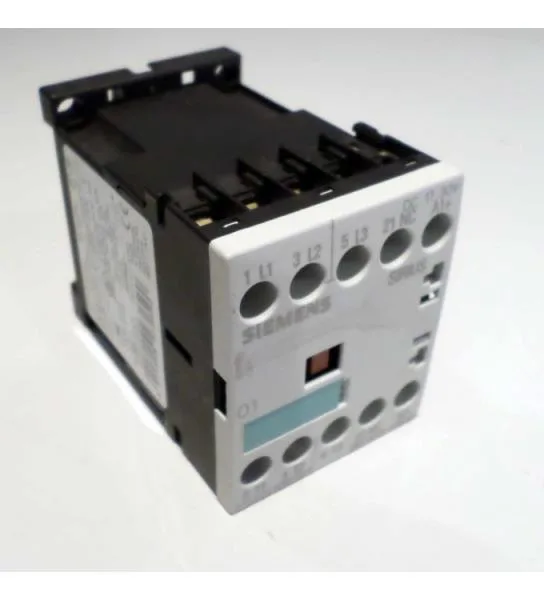
What it is — and what the ratings mean for fit
The Siemens 3RT1015-2AP61 is a SIRIUS-branded power contactor in the compact S00 frame size, designed for switching motor loads in control panels. It mounts via screw or snap-on onto 35 mm standard mounting rail per DIN EN 50022, and the 45 mm width means it fits tightly in a multi-contactor row without wasting rail space. The headline motor ratings are 3 kW at 400 V under AC-2 duty — the category for slip-ring motor starting and reversing — and 4 kW at 690 V. That 690 V figure is the one to watch if you're feeding a motor on a 690 V industrial network; the contactor handles it without derating in the standard S00 package. For AC-4 switching (plugging, inching, reversing under load), the rated operational current is 6.5 A at 400 V. That's the number that governs contact life in high-duty-cycle reversing applications — not the AC-2 power figure. The main circuit uses spring-loaded terminals, accepting 2x (0.25 to 2.5 mm²) solid or stranded, or 2x (24 to 14 AWG). No screw torque to verify on installation — just strip to 8-10 mm and push in. One normally open instantaneous auxiliary contact is built in, rated 10 A at 24 V, 6 A at 230 V, and 3 A at 400 V. That single aux is enough for a feedback signal to a PLC input or a seal-in circuit, but if you need more than one aux contact, you'll add a side-mount block.
Coordination and protection — what the fusing specs tell you
For Type 2 coordination (no damage to the contactor after a short circuit), the evidence specifies a gL/gG fuse rated 20 A. For Type 1 coordination (contactor may need replacement but the rest of the panel is safe), the fuse can go up to 35 A. That's the spec your panel designer needs to match the upstream protection to the contactor's withstand. The contactor is rated for pollution degree 3, meaning it's suitable for industrial environments with conductive pollution or dry non-conductive pollution that becomes conductive due to condensation. No conformal coating required inside a standard IP20 panel enclosure.
Environmental limits and mounting
Operating temperature range is -25 to +60 °C, which covers most indoor panel environments including unventilated cabinets near process equipment. Maximum operating altitude is 2,000 m — above that, you'd need to derate or switch to a higher-altitude variant. The enclosure is IP20 on the front and at the terminals, so it's protected against solid objects larger than 12 mm (fingers) but not against moisture. Install inside a panel with at least IP54 enclosure rating if washdown or condensation is a concern. Side-by-side mounting is permitted with a 6 mm gap at the side, which means you can pack contactors tightly on the DIN rail without derating, as long as you maintain that clearance for heat dissipation. Mechanical endurance is rated at 30 million operating cycles — that's the theoretical life of the mechanism under no-load or light-load switching. Contact life under full motor current will be lower and depends on the duty category.
Sourcing and lifecycle
For a BOM line that calls out 3RT1015-2AP61, the fit is confirmed by the S00 frame size, the spring-loaded terminals, and the 3 kW AC-2 rating. The 45 mm width and DIN-rail mounting match the standard panel layout for this class.
