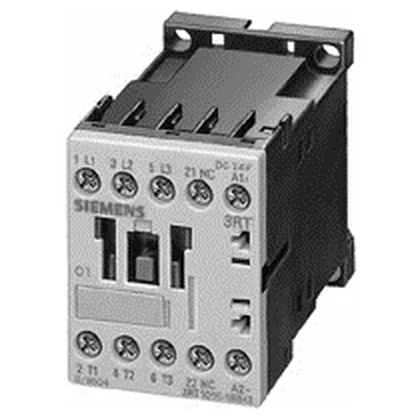
What this contactor is and where it fits
The Siemens 3RT1015-2BB42-ZW95 is a SIRIUS power contactor in frame size S00, built for switching motor loads and resistive loads in industrial control panels. The 24 VDC coil draws 3.3 W during closing and holding, so the DC supply needs to deliver that continuously — no issue for a standard 24 VDC power supply, but worth noting if you're sharing a bus with sensitive electronics. Mounting is screw or snap-on onto 35 mm DIN rail per DIN EN 50022, which is the standard for panel builders. The 45 mm width and 73 mm depth mean it fits a standard 45 mm slot on the rail — no surprises when laying out a row of contactors and overloads. Spring-loaded terminals on the main current circuit accept 2x (0.25 to 2.5 mm²) solid or stranded wire, or 2x (24 to 14 AWG). That's the same termination as the 3RT1015-1BB42 variant, so a panel wired for the screw-terminal version won't need terminal block changes — just a different wiring habit (no screwdriver torque check).
Ratings that matter for motor switching
Rated operational current at 24 V is 10 A (AC-12), which covers control transformer and resistive loads at that voltage. For motor duty at 400 V, the AC-2 rating is 3 kW, and AC-4 at 400 V is 6.5 A — that's the heavy inrush/plugging duty cycle rating. If you're switching a motor that starts and stops frequently or reverses, the AC-4 figure is the one to size against. Short-circuit protection coordination: Type 2 coordination requires a gL/gG fuse rated 20 A; Type 1 coordination allows up to 35 A. That's the difference between the contactor surviving a fault (Type 2) versus needing replacement after a fault (Type 1). For most production lines, Type 2 is the standard — the 20 A fuse limit is what you'll spec into the BOM. Mechanical endurance is 30 million operations typical — that's the contactor itself, not the contacts under load. Electrical life depends on the switching current and duty cycle, but the mechanical figure tells you the coil and armature are built for high-cycle applications like conveyor indexing or packaging machinery.
Panel integration notes
Side-by-side mounting is allowed with 6 mm spacing at the side, which is typical for S00 contactors — no derating required for adjacent units in still air at 40 °C ambient. Operating temperature range is -25 to +60 °C, so it handles warm enclosures without forced ventilation in most industrial settings. Degree of pollution 3 means it's rated for conductive pollution environments — typical for factory floors where dust, oil mist, or humidity are present. The IP20 finger-safe protection on the front and terminals is standard for enclosed panels; no special sealing needed inside a cabinet.
