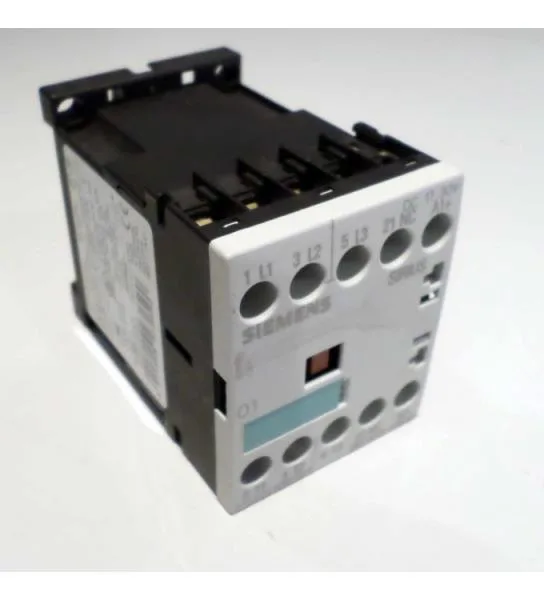
It's rated for 10 A in AC-12 duty, which is the resistive-load category — think heaters, incandescent lamps, or transformer primaries where inrush is modest. The 230 V AC coil is a standard industrial control voltage across Europe and much of Asia. The AC-12 rating is the headline number that governs the fit: 10 A at the rated insulation voltage. That's not a motor-switching figure — for motor loads you'd look at the AC-3 or AC-4 ratings, which are lower for this frame size. At 230 V the contactor is rated for 6 A (AC-1), and at 400 V for 3 A (AC-1).
The 45 mm width (one HP, or horizontal pitch) means it occupies a single 9 mm module space on the rail. Depth is 73 mm, height 60 mm, so it clears most shallow enclosures. Side-by-side mounting is permitted, which is useful when packing multiple contactors into a tight gland plate layout. Main circuit connections are spring-loaded terminals, accepting 2x (0.25 to 2.5 mm²) solid or stranded wire, or 2x (24 to 14 AWG). Spring-cage terminations are faster to wire than screw clamps and hold well under vibration — worth noting if the panel sees transport or machine-mounted duty. It's not a clean-room part, but it's not meant for outdoor exposure either.
The AC-12 rating of 10 A sets the thermal current limit for resistive loads — don't exceed that. For motor loads, the relevant figure is the AC-3 rating (not explicitly listed here but typically around 4 kW at 400 V for S00 frame). The coil draw is 3.3 W both closing and holding — a DC-operated coil that stays cool in continuous service. That's a high figure — for a contactor switching once per minute, that's about 57 years of continuous operation. Electrical life will be lower and depends on the switched load; the AC-12 figure is the best case.