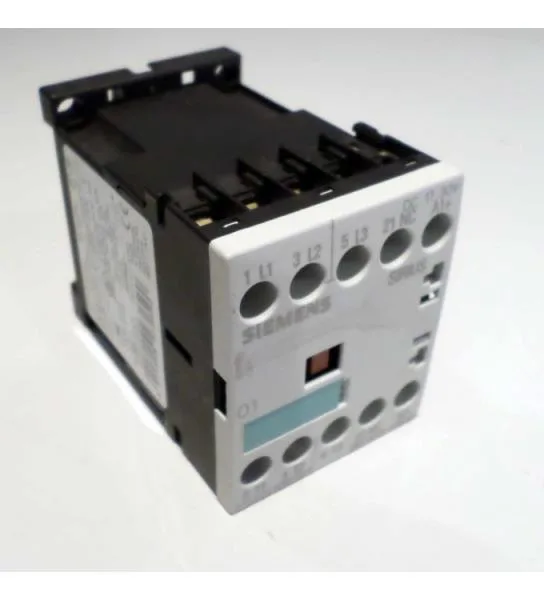
Side-by-side mounting is allowed, saving rail space when grouping multiple contactors. Rated for AC-12 duty at 10 A and AC-3 at 400 V for a 3 kW motor, this contactor handles typical conveyor, pump, and fan loads within the S00 frame's thermal budget. The 24 VDC coil draws 2.3 W holding power — consistent with PLC-driven control circuits that need low coil dissipation.
The 3RT1015-2HB41 is rated for AC-3 switching at 400 V up to 3 kW, and at 690 V up to 4 kW. AC-3 is the standard motor-starting duty class per IEC 60947-4-1 — the contactor must make and break the motor's locked-rotor current. The 3 kW figure at 400 V tells you it's sized for a 3 kW induction motor on a 400 V three-phase supply; the 4 kW at 690 V reflects the lower current at higher voltage. For resistive loads (AC-1), the contactor is rated 10 A at 230 V and 6 A at 400 V. Resistive duty is less demanding than motor starting, so the contactor can carry its full thermal current continuously in heater or lighting circuits. The coil operates at 24 VDC with a closing and holding power of 2.3 W. That's a standard PLC output voltage — no separate power supply needed if your control system runs 24 VDC. The coil's pull-in current is higher than holding, but the 2.3 W figure is the steady-state dissipation after closure. The IP20 front and terminal protection means it's touch-safe but not sealed against water ingress; mount it inside a panel with a suitable enclosure rating.
No surplus or broker channel needed. The contactor carries the standard Siemens SIRIUS warranty and compliance documentation (CE, UL, CSA, RoHS, REACH) — ask for the specific declaration when you RFQ.
Integration notes
Depth is 73 mm, which clears most 80 mm deep enclosures. Height is 60 mm, so it fits under standard 100 mm cover clearance. Spring-loaded terminals accept 2x (0.25... 2.5 mm²) solid or stranded wire, or 2x (24... 14 AWG). No ferrules required, but recommended for stranded wire to prevent fraying. The terminals are IP20 touch-safe, so you can work on them live if needed — though standard lockout/tagout practice still applies. This matters when designing the upstream protection in the panel. The contactor is rated for operation up to 2,000 m altitude without derating. Above that, the air density drop reduces the dielectric strength and cooling — consult the derating curve if your installation is above 2,000 m.