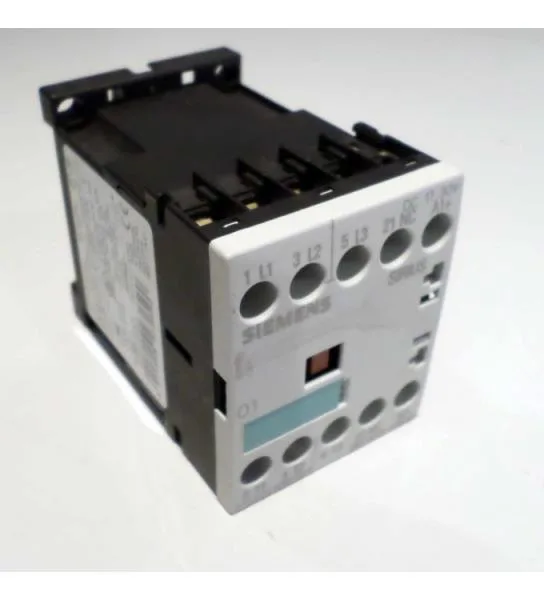
The main contacts are spring-loaded terminals accepting 2x (0.25... 2.5 mm²) solid or stranded wire, or 2x (24... 14) AWG.
The headline rating is 10 A at AC-12 (resistive load), which is the maximum continuous current the main contacts can carry in that duty class. For motor switching, the AC-3 rating at 400 V is 3 kW (about 6.5 A), and at 690 V it reaches 4 kW — so this contactor is sized for small three-phase motors up to roughly 4 kW at line voltage. Short-circuit coordination is specified: with type 2 coordination, use a gL/gG fuse rated 20 A; with type 1 coordination, 35 A. This tells the panel builder what upstream protection preserves the contactor after a fault. The auxiliary contact block is rated for switching at various control voltages: 10 A at 24 V, 6 A at 230 V, 3 A at 400 V, and 0.3 A at 220 V DC — covering both AC and DC control circuits.
The auxiliary contact block uses the same terminal type, keeping the wiring method consistent across the device.