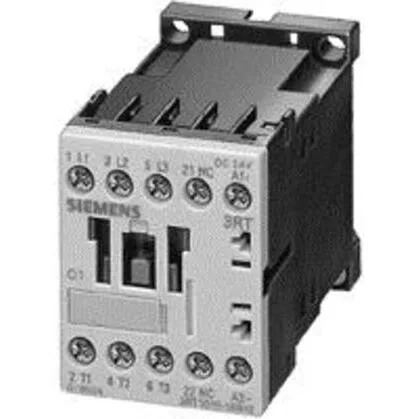
It's a current-production part. Coil is 24 V rated, accepting both AC and DC (50 Hz and 60 Hz), with a rated operating range of 0.8...1.1 at 50 Hz and 0.85...1.1 at 60 Hz. That means the coil holds in reliably even if the control voltage sags a bit — good for long cable runs from a PLC output. Main contacts are screw-type terminals, accepting 2x (0.5...1.5 mm²), 2x (0.75...2.5 mm²), and max 2x (0.75...4 mm²) solid or stranded. AWG equivalents: 2x (20...16), 2x (18...14), 1x 12. That's enough wire range for most motor circuits up to 5.5 kW.
AC-4 at 400 V gives 8.5 A, covering plugging and inching applications. For resistive loads (AC-12), it handles 10 A continuous. At 690 V it's rated 5.5 kW, which is the typical max for this frame size. That's enough for a 7.5 HP motor at 480 V or a 5.5 kW motor at 690 V, but check your actual load current — the motor FLA is what matters, not the kW rating alone. Short-circuit coordination: Type 2 requires a 20 A gL/gG fuse; Type 1 allows a 35 A gL/gG. Type 2 means the contactor remains usable after a fault — the fuse clears before the contacts weld. If your panel spec calls for Type 2, you need the 20 A fuse. Mechanical life is typical 30 million operations — that's the mechanical endurance, not electrical. Electrical life will be lower depending on load current and duty cycle, but 30 million means the actuator and spring system are built for years of cycling in a machine.
That's tight — you can pack multiple contactors in a row without extra spacing, but keep the 6 mm for heat dissipation. IP20 on the front and at the terminals — finger-safe, but not washdown. That's the standard S00 footprint — fits in the same space as any other S00 contactor from the SIRIUS family.
Auxiliary and control circuit
One instantaneous auxiliary contact (1 NO or 1 NC — the order code suffix determines which). For 24 V DC control, the contact is rated 10 A at 24 V, derating to 2 A at 60 V, 1 A at 110 V, 0.3 A at 220 V, and 6 A at 230 V AC. That's enough to signal a PLC input or drive a small indicator lamp. The coil draws its rated voltage at 24 V. The wide operating range (0.8...1.1 at 50 Hz) means it picks up reliably even if the supply dips.