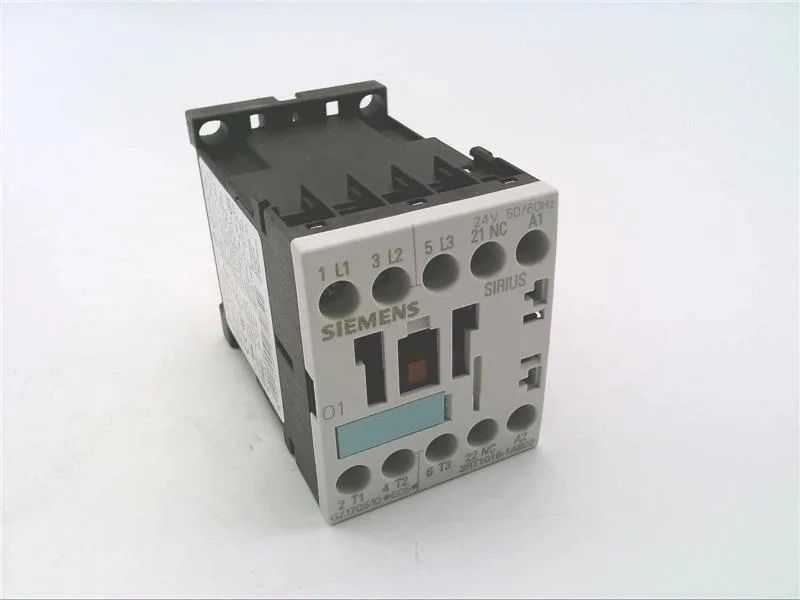
Operating range 0.8 to 1.1 at 50 Hz, 0.85 to 1.1 at 60 Hz. The 45 mm wide, 57.5 mm tall, 72 mm deep footprint is compact for a contactor that can switch 4 kW at AC-2 duty on 400 V or 8.5 A at AC-4. For motor loads at higher voltages, it handles 4.5 kW at 500 V and 5.5 kW at 690 V.
The AC-2 rating (4 kW at 400 V) covers slip-ring motor starting and reversing — common on crane and hoist duty. If your application is straightforward across-the-line starting of a squirrel-cage motor, the thermal current rating governs, but these duty-cycle ratings tell you whether the contactor survives repeated reversals. DC switching is specified for several voltages: 10 A at 24 V, 6 A at 230 V, 3 A at 400 V, and 0.3 A at 220 V. That covers DC braking circuits, solenoid valves, and control transformers on the DC side. The 2 A at 60 V rating is useful for some older DC bus systems. Screw terminals accept 2x (0.5 to 1.5 mm²), 2x (0.75 to 2.5 mm²), or max 2x (0.75 to 4 mm²) solid or stranded. AWG equivalents are 2x (20 to 16), 2x (18 to 14), and 1x 12. The IP20 finger-safe protection on the front and terminals means it's safe to work on in an energized panel — but keep the dust out in a cement plant environment; the contactor itself isn't sealed against airborne grit.
For Type 2 coordination (contactor remains operational after a fault), the fuse drops to gL/gG 20 A. Type 2 is standard for most industrial panels to avoid unplanned downtime — if your BOM calls for Type 2, spec the 20 A fuse. Rated for installation up to 2,000 m altitude without derating. The 30 million mechanical cycles typical rating gives a long service life for frequent switching applications.