For AC-4 (plugging/reversing) at 400 V, it's rated 8.5 A.
Mechanical life is listed at 30,000,000 operations — that's the expected cycles before mechanical wear, not electrical endurance under load. Electrical life will be lower and depends on the switched current and duty class. Altitude limit is 2,000 m — above that, derate for air density and dielectric breakdown.
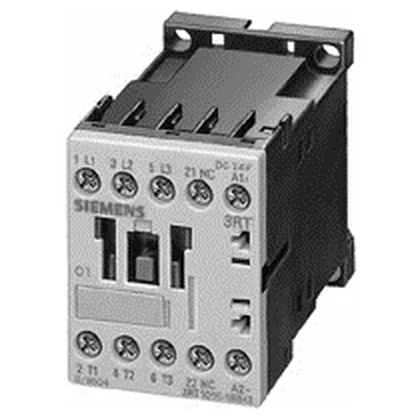
Main circuit terminals are screw-type, accepting 2x (0.5 to 1.5 mm²), 2x (0.75 to 2.5 mm²), or max 2x (0.75 to 4 mm²) solid/stranded. AWG equivalents are 2x (20 to 16), 2x (18 to 14), and 1x 12. That's enough cross-section for the rated currents without doubling up conductors unnecessarily. Front protection is IP20 — safe from finger contact but not washdown. Side clearance of 6 mm is required for heat dissipation when mounting side-by-side, which is permitted. The contactor's depth is 72 mm, height 57.5 mm, fitting standard 100 mm deep enclosures.
These values are per IEC 60947-4-1 and guide the panel builder's fuse selection for the motor branch circuit. The contactor operates at 50/60 Hz with a rated control supply voltage of 42 V at 50 Hz and 42 V at 60 Hz — that's the coil voltage, not the main circuit voltage. The main circuit can switch up to 690 V, with a 5.5 kW rating at that voltage level.
The closest functional peer is the 3RT1016-2AP02, which shares the same Size S00 frame and basic ratings but differs in terminal type or auxiliary configuration. If your panel was wired for the -2AP02 variant, verify the terminal layout and any auxiliary contact count before substituting — the mounting footprint and coil voltage are identical, so it will drop into the same DIN rail position without rewiring the main power circuit.