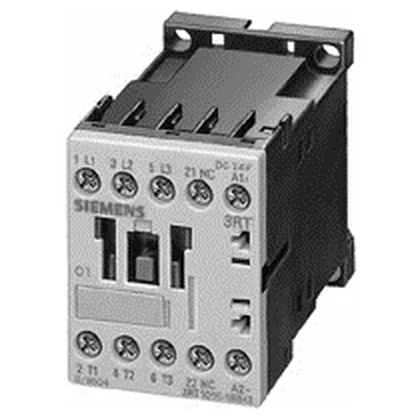
The Siemens 3RT1016-1AH05 is a SIRIUS-brand power contactor in the compact Size S00 frame — the smallest footprint in the SIRIUS family, designed for controlling motors and resistive loads up to 5.5 kW at 690 V in AC-3 duty. The 45 mm width and 57.5 mm height let it nest tightly on a 35 mm DIN rail (DIN EN 50022) alongside other S00 components, with side-by-side mounting permitted without derating when the ambient stays within the -25 to +60 °C operating range.
The headline motor-switching capability is 4.5 kW at 500 V and 5.5 kW at 690 V in AC-3 duty — that is the standard induction-motor category (starting and disconnecting running motors). For AC-2 duty at 400 V (slip-ring motors or wound-rotor applications) it is rated 4 kW. For resistive loads (AC-1 / AC-12) the maximum operating current is 10 A. The DC switching ratings are given per pole: 10 A at 24 V, 2 A at 60 V, 1 A at 110 V, 0.3 A at 220 V, 6 A at 230 V, 3 A at 400 V — these are the currents the contacts can break in DC circuits, which is significantly more demanding than AC due to the lack of a natural zero-crossing arc extinction. The coil operates on a 24 VDC supply with a tolerance band of 0.8 to 1.1 times rated voltage at 50 Hz and 0.85 to 1.1 at 60 Hz — so it picks up reliably from about 19.2 VDC and drops out below the lower threshold, which matters for brownout ride-through planning.
Short-circuit coordination and wiring
The main circuit screw-type terminals accept solid or stranded conductors: 2x (0.5 to 1.5 mm²), 2x (0.75 to 2.5 mm²), or up to 2x (0.75 to 4 mm²) maximum — also specified as 2x (20 to 16 AWG), 2x (18 to 14 AWG), or 1x 12 AWG.
The closest functional sibling is the 3RT1016-1AG61, which shares the same S00 frame, 3-pole main contacts, screw terminals, and identical AC-3 motor ratings. The difference is the coil voltage: the 1AG61 uses a 230 VAC / 240 VAC coil, while the 1AH05 uses 24 VDC. If your control circuit is 24 VDC — which is the standard for most PLC-based panels — the 1AH05 is the correct choice. Dropping a 24 VDC contactor into a panel wired for 230 VAC coil control would require a separate 24 VDC supply or a relay interface; conversely, using a 230 VAC coil in a 24 VDC panel means adding a control transformer. The physical footprint, mounting rail, and terminal layout are identical, so no rewiring of the power circuit is needed if swapping between the two — only the coil supply must match.