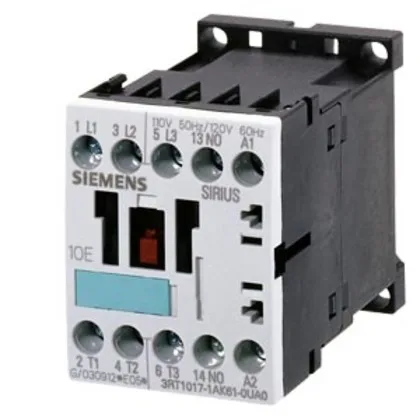
For AC-3 motor duty, it handles 4.5 kW at 500 V and 5.5 kW at 690 V. The AC-4 reversing/inching rating is 8.5 A at 400 V, which is the figure that governs frequent jogging or plugging applications — the AC-3 number is higher but the AC-4 limit is what you size for when the contactor sees inrush on every cycle.
The -ZW97 suffix indicates a special version. Verify with your Siemens contact whether this suffix carries any particular marking or packaging difference from the base 3RT1016-1AK61.
The depth matters for gland-plate clearance if you're mounting it near the back of a shallow enclosure — 72 mm plus wiring space means you need at least 100 mm from the DIN rail to the back wall. Screw-type terminals on the main circuit accept 2x (0.5 to 1.5 mm²), 2x (0.75 to 2.5 mm²), or max 2x (0.75 to 4 mm²) solid or stranded. For AWG, that's 2x (20 to 16), 2x (18 to 14), or 1x 12. The auxiliary contact block (1 N/O instantaneous) uses the same terminal range. Front face is IP20, terminals are IP20 — standard for enclosed panel use. For fuse coordination, Type 2 (no damage) requires a 20 A gL/gG fuse; Type 1 (allow damage) allows up to 35 A gL/gG.
The 3RT1016-2AP02 is the same S00 frame size and same AC-3 power ratings, but it uses spring-cage terminals instead of screw terminals. If your panel is wired with ferruled stranded conductors and you prefer tool-less insertion, the -2AP02 saves termination time. The -1AK61 with screw terminals is more forgiving for mixed conductor sizes and field retrofits where the wire prep varies. Both mount on the same 45 mm DIN footprint — no panel layout change needed to swap between them.