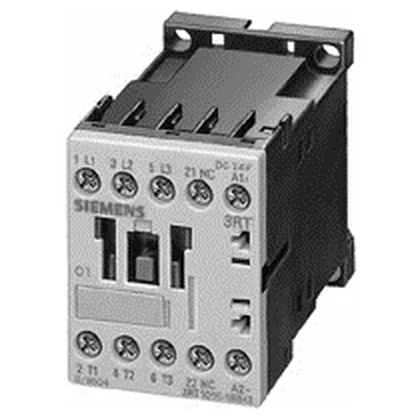
It's rated for 10 A maximum operating current in AC-12 duty (resistive loads like heaters or lighting), and 4 kW at 400 V in AC-2 duty (slip-ring motors, where the contactor makes and breaks the rotor circuit under load).
Front face is IP20, terminals are IP20, so it's safe for finger-probe access inside an enclosure.
Terminals and wiring
Main circuit terminals are screw-type, accepting 2x (0.5 to 1.5 mm²), 2x (0.75 to 2.5 mm²), or up to 2x (0.75 to 4 mm²) — or 1x 12 AWG. That's enough for paralleling two smaller conductors or landing one larger one. Auxiliary contact ratings are given at multiple voltages: 10 A at 24 V, 6 A at 230 V, 3 A at 400 V, and 0.3 A at 220 V — so the same auxiliary block handles both low-voltage DC pilot circuits and higher-voltage AC indication.
For Type 1 coordination (no damage after a short circuit, but the contactor may need replacement), the required fuse is gL/gG 35 A. For Type 2 coordination (contactor remains usable after a fault), the fuse is gL/gG 20 A. That's a real difference in selectivity planning — Type 2 keeps the line running after a downstream fault, but needs a smaller fuse. Mechanical endurance is 30 million operations typical, so this contactor outlasts most machines in cyclic duty.