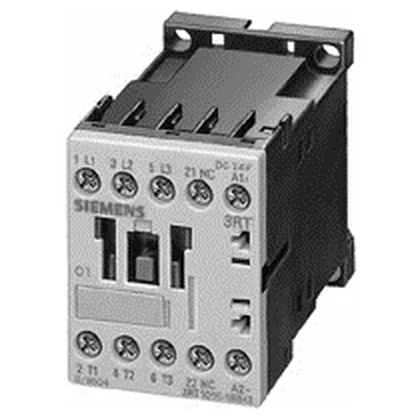
What this SIRIUS S00 contactor is and where it lands
The Siemens 3RT1016-1AM25-ZX95 is a SIRIUS power contactor in the S00 frame size, rated for 24 VDC coil operation at 10 A. It's a current-production part (active lifecycle stage) built for switching motor loads and resistive circuits in industrial control panels. The screw-type terminals accept 2x (0.5 to 1.5 mm²) solid or 2x (0.75 to 2.5 mm²) stranded, with a max of 2x (0.75 to 4 mm²) — that's the wiring envelope for the main current circuit. Mounting is screw or snap-on onto a 35 mm standard rail per DIN EN 50022. The 45 mm width and 57.5 mm height mean it fits a standard DIN slot, and the 114 mm depth leaves room for gland plates and wiring ducts in a typical enclosure. Side-by-side mounting is allowed — no derating gap required between units on the rail.
Coordination and protection — what the fuse ratings mean for your panel
For Type 2 coordination (no damage to the contactor under short circuit), the spec calls for a gL/gG fuse rated 20 A. For Type 1 coordination (contactor may need replacement but the installation is safe), the fuse goes up to 35 A gL/gG. That's the difference between a fuse that protects the contactor itself versus one that only clears the fault. If you're building to IEC 60947-4-1, the Type 2 rating is what keeps the contactor in service after a fault — worth noting if the panel is in a hard-to-reach location.
Switching capacity across voltages — where this contactor works hardest
At 24 V rated value the contactor handles 10 A; at 230 V it's rated 6 A; at 400 V it drops to 3 A. For motor loads in AC-2 duty at 400 V, the rated power is 4 kW; in AC-4 duty at 400 V, the operating current is 8.5 A. The 690 V rating pushes 5.5 kW. That spread tells you this is a general-purpose S00 contactor — fine for small motors, resistive heaters, and lighting banks up to about 5.5 kW at higher line voltages. The 30 million mechanical cycles typical life means it outlasts most panel refreshes.
Environmental limits and installation conditions
Operating temperature range is -25 to +60 °C during operation, with a maximum operating altitude of 2000 m. The IP20 rating on the front and at the terminal means it's protected against solid objects larger than 12 mm — standard for inside an enclosure, not for washdown zones. Pollution degree 3 (conductive pollution or dry non-conductive that becomes conductive due to condensation) is the rating, so it expects a reasonably clean panel environment or conformal coating on adjacent PCBs.
