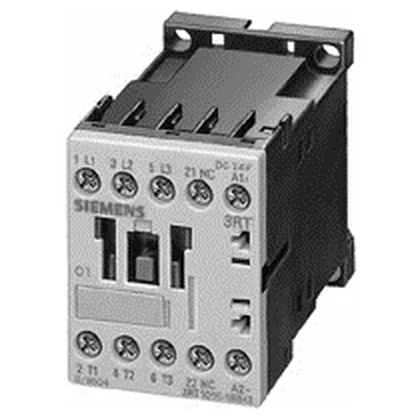
It carries a motor rating of 4.5 kW at 500 V and 5.5 kW at 690 V, making it suited for 400 V class drives where the line voltage runs higher than standard 400 V. The AC-2 rating at 400 V is 4 kW, which covers wound-rotor motor duty; the AC-4 rating at 400 V is 8.5 A, covering plugging and inching applications where the contactor makes and breaks stalled-rotor current.
The S00 footprint is 45 mm wide, 57.5 mm tall, and 111 mm deep, so it occupies one standard 45 mm module slot on the rail. Side-by-side mounting is permitted, meaning you can gang multiple units without spacing — useful when building a motor starter cluster in a compact enclosure.
Main circuit and auxiliary/control circuits both use screw-type terminals. The main contacts accept 2x (0.5 to 1.5 mm²), 2x (0.75 to 2.5 mm²), or max 2x (0.75 to 4 mm²) solid or stranded conductors; AWG equivalents are 2x (20 to 16), 2x (18 to 14), or 1x 12. The auxiliary contacts use the same wire ranges. This covers typical control wiring from 1.5 mm² for coil circuits up to 4 mm² for motor feeders.
Coil and control circuit ratings
The coil operating range is 0.8 to 1.1 times rated voltage at 50 Hz and 0.85 to 1.1 at 60 Hz, giving a pickup window that accommodates typical line sag. The auxiliary contact ratings at various voltages are: 10 A at 24 V, 2 A at 60 V, 1 A at 110 V, 0.3 A at 220 V, 6 A at 230 V, and 3 A at 400 V. These are the switching capacities for the built-in auxiliary contacts — useful for interlocking, status feedback, or PLC input signals.
Protection and coordination
For short-circuit protection, type 1 coordination requires a gL/gG fuse rated 35 A; type 2 coordination requires a 20 A gL/gG fuse. Type 2 coordination limits contactor damage to a weld risk after a fault, which is the standard for most motor starter applications where downstream downtime matters. The mechanical endurance is 30 million cycles, so the contactor outlasts the machine in typical cyclic duty.