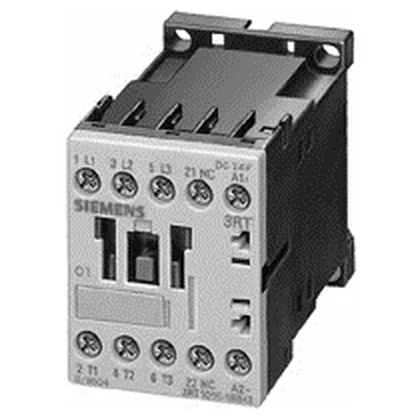
It switches three-phase motor loads up to 4 kW at 400 V in AC-3 duty, or 8.5 A in AC-4 (inching/plugging) service. The 45 mm wide housing mounts on 35 mm DIN rail per EN 50022, with screw-type terminals accepting 2x (0.5 to 1.5 mm²) solid or 2x (0.75 to 2.5 mm²) stranded, up to 4 mm² max. IP20 finger-safe protection on the front and terminals means it's panel-ready without additional shrouding in a standard enclosure.
AC-3 motor switching at 400 V is rated 4 kW — that's the headline number for selecting this contactor to drive a standard squirrel-cage induction motor. The same contactor carries an AC-4 rating of 8.5 A at 400 V, which governs frequent reversing or jogging duty where contacts see inrush on each closure. For resistive loads (AC-1), the maximum operating current is 10 A. The auxiliary contact block (not included in this base unit) handles DC loads: 10 A at 24 V, 2 A at 60 V, 1 A at 110 V, 0.3 A at 220 V — these are the limits for pilot duty on solenoids or indicator lamps. Short-circuit coordination requires a gL/gG 20 A fuse for Type 2 coordination or 35 A for Type 1.
The 114 mm depth includes the terminal projection — verify enclosure depth if mounting against a back panel.
Mechanical endurance and frequency tolerance
Mechanical endurance is 30 million operating cycles typical — this is the contactor's design life under no-load or light-load switching, not the electrical life under full motor current. For motor duty, electrical life will be lower and depends on the switching frequency and load current. The contactor is rated for both 50 Hz and 60 Hz supply, with a voltage tolerance factor of 0.8 to 1.1 at 50 Hz and 0.85 to 1.1 at 60 Hz — meaning it can operate reliably with supply voltage variations from -20% to +10% at 50 Hz, or -15% to +10% at 60 Hz.