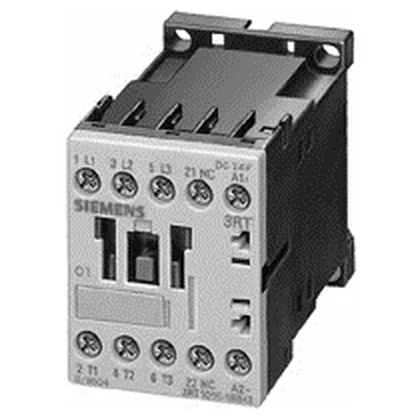
The coil pulls in at 24 VDC and the contactor is rated to switch 4 kW at 400 V under AC-2 duty (slip-ring motor starting), and 8.5 A under AC-4 (reversing or inching duty).
AC-2 at 400 V is rated 4 kW — that's the motor power you can reliably switch for slip-ring or wound-rotor motors. AC-4 at 400 V is rated 8.5 A, which covers reversing and inching duty. For resistive loads (AC-12), the maximum operating current is 10 A. For Type 1 coordination (contactor may need replacement after fault), you can go up to 35 A gL/gG. That's the standard for most control panels that aren't in a clean room — no special derating needed for a typical factory floor install. Mechanical endurance is listed at 30 million operating cycles typical. That's the mechanical life of the contactor — the number of times the armature can open and close before wear. Electrical life will be lower and depends on the load current and switching frequency, but 30 million cycles means this contactor will outlast most machines in the panel.
Mounting and integration notes
The S00 frame is 45 mm wide, 57.5 mm tall, and 72 mm deep — that's a compact footprint that leaves room for aux contact blocks or a solid-state overload relay alongside it on the rail. Side-by-side mounting is allowed, with a 6 mm clearance to adjacent devices on the side. Front protection is IP20, so the terminals are finger-safe once the panel door is closed. Wire sizes for the main circuit: accepts 2x (0.5 to 1.5 mm²), 2x (0.75 to 2.5 mm²), or max 2x (0.75 to 4 mm²) solid or stranded. For AWG, that's 2x (20 to 16), 2x (18 to 14), or 1x 12. The screw terminals are the standard box-clamp type — strip about 8 mm, torque to the value on the nameplate, and you're done.
Ambient temperature range during operation is -25 to +60 °C. Frequency tolerance is 0.85 to 1.1 of rated value at both 50 Hz and 60 Hz, so it's fine on either supply frequency without adjustment.