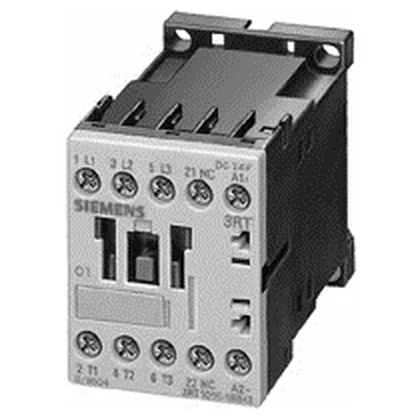
It's rated for 4 kW at 400 V AC-3 and 5.5 kW at 690 V AC-3, making it a fit for small to medium induction motors on pumps, fans, and conveyors. The 45 mm width and 57.5 mm height let it pack into tight DIN-rail enclosures, and it mounts via screw or snap-on onto 35 mm rail per DIN EN 50022.
The AC-3 rating at 400 V is 4 kW — that's the motor switching duty you'll use most often. For auxiliary contacts, the 24 V DC rating is 10 A, which drops to 0.3 A at 220 V DC — that's the inductive load curve; don't expect the same current at higher voltages. The contactor carries a rated insulation voltage of 500 V at 50/60 Hz, and the operating voltage range is 0.8 to 1.1 times the rated value at 50 Hz, 0.85 to 1.1 at 60 Hz. That means it holds in during sags down to about 80% of nominal coil voltage — important for brownout ride-through on a line. Mechanical endurance is listed at 30 million operations typical — that's a long service life for a contactor this size, so it's not a part you'll be swapping every year in a moderate-duty cycle.
Both main and auxiliary circuits use screw-type terminals. The main terminals accept 2x (0.5 to 1.5 mm²) solid, 2x (0.75 to 2.5 mm²) stranded, or up to 2x (0.75 to 4 mm²) max. For AWG, that's 2x (20 to 16) solid, 2x (18 to 14) stranded, or 1x 12. The auxiliary contacts have the same wire range. This is standard for panel wiring — no special ferrules needed, but stranded wire benefits from bootlace ferrules for a clean termination. The contactor is rated IP20 on the front and at the terminals — that's finger-safe but not washdown-rated. It's meant for enclosed panels, not open-floor mounting.
That's the spec for the main circuit — your upstream breaker or fuse block should be sized accordingly.