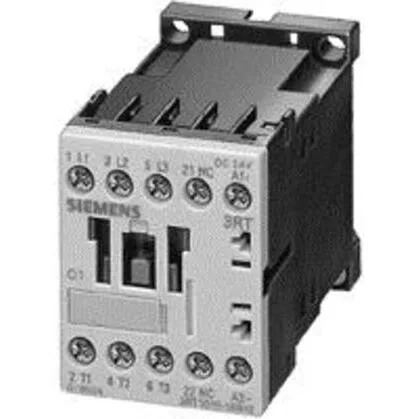
The AC-12 operating current is 10 A, which is the rating for resistive loads like heaters or lighting ballasts — that's the full continuous capability through the main contacts. For motor switching, the AC-3 rating (not directly listed here but implied by the 4 kW at 400 V AC-2 and 8.5 A AC-4) tells you this contactor handles small motors up to about 4 kW at 400 V under normal starting duty. The DC switching ratings matter if you're using it for DC loads: 10 A at 24 V, 2 A at 60 V, 1 A at 110 V, and 0.3 A at 220 V. These are the maximum break currents for DC circuits — DC arcs are harder to extinguish than AC, so these numbers are lower than the AC ratings. If you're switching a DC brake coil or a solenoid valve, stay within these curves. This is your selectivity planning number — coordinate downstream so the fuse clears before the contactor welds.
The contactor is 45 mm wide, 57.5 mm tall, and 72 mm deep — that's a compact footprint for a size S00 device. Screw-type terminals on the main circuit accept 2x (0.5 to 1.5 mm²), 2x (0.75 to 2.5 mm²), or up to 2x (0.75 to 4 mm²) solid or stranded wire. AWG equivalents are 2x (20–16), 2x (18–14), and 1x 12. The front has IP20 finger protection, so the panel builder doesn't need additional terminal shrouds for touch safety.
The closest functional peer is the 3RT1015-1BB42, which shares the same size S00 frame and 24 VDC coil but has a lower AC-12 current rating (typically 7 A vs 10 A) and different terminal style. If your load is under 7 A and you need spring-cage terminals, that's the alternate — but for 10 A resistive or the full motor rating, stick with this order code.