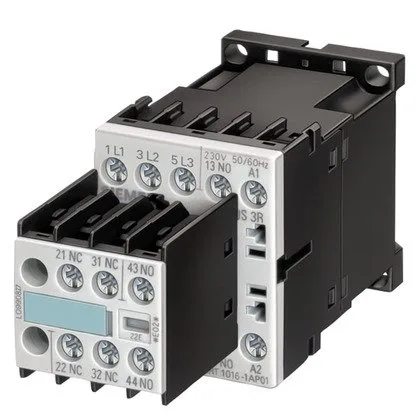
The coil is rated 24 VDC with a pickup threshold of 0.85 and a dropout threshold of 1.1 times rated voltage, meaning it pulls in reliably at about 20.4 V and drops out at about 26.4 V. Main circuit terminals are screw-type, accepting 2x (0.5 to 1.5 mm²), 2x (0.75 to 2.5 mm²), or max 2x (0.75 to 4 mm²) solid or stranded conductors. AWG equivalents are 2x (20 to 16), 2x (18 to 14), and 1x 12. That covers most panel wiring up to 4 mm² without needing bootlace ferrules, though ferruled stranded is fine within the same cross-section range.
The contactor is rated for AC-2 duty at 400 V at 4 kW, and AC-4 at 400 V at 8.5 A. AC-2 covers slip-ring motor starting and reversing; AC-4 covers plugging and inching of squirrel-cage motors. For resistive loads (AC-12), the maximum operating current is 10 A. Motor power ratings at higher line voltages: 4.5 kW at 500 V and 5.5 kW at 690 V. That makes it suitable for 400 V class motors up to about 4 kW, and for 690 V delta-connected motors up to 5.5 kW, common in mining or heavy industrial installations. Short-circuit protection coordination: with type 2 coordination (no welding of contacts on fault), use a gL/gG fuse rated 20 A. With type 1 coordination (contacts may weld but no fire or shock hazard), use a 35 A gL/gG fuse. The 20 A recommendation is the one most panel designers spec for selectivity downstream of a motor circuit breaker.
Degree of protection is IP20 on the front and at the terminals, which is standard for enclosed panel mounting — no finger-safe shrouding needed inside a locked cabinet.
That is useful for panel documentation and for matching the part to a pre-labeled schematic.