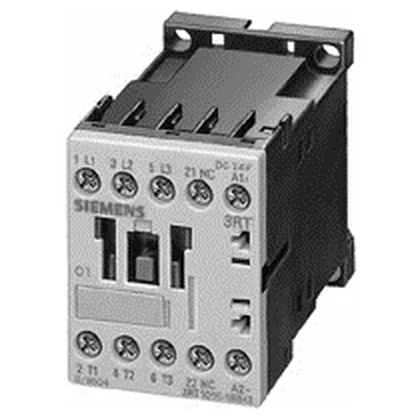
SIRIUS S00 power contactor, 24 V DC coil — what fits the BOM line
It pulls 3.3 W on pick-up and holds at 3.3 W, so the DC supply doesn't need a big inrush allowance; a simple 24 VDC PSU sized for the holding load of several contactors works fine. Size S00 means it's compact: 45 mm wide, 57.5 mm tall, 111 mm deep. That's a standard 45 mm slot on a DIN rail — no special panel layout needed. The main circuit uses screw-type terminals that accept 2x (0.5 to 1.5 mm²), 2x (0.75 to 2.5 mm²), or max 2x (0.75 to 4 mm²) — also 1x 12 AWG. That covers the common motor feeder sizes up to about 4 mm² without needing bootlace ferrules, though ferruled stranded is fine. The front is IP20, side-by-side mounting is allowed, and the side clearance is 6 mm.
Motor ratings and coordination — what the AC numbers mean for the load
For motor switching, the AC-3 rating at 400 V is 4.5 kW, and at 690 V it's 5.5 kW. In AC-4 (reversing or inching) at 400 V it's rated 8.5 A, so if you're doing plugging or jogging, that's the current limit to watch. For coordination, with Type 2 coordination required, the fuse is gL/gG 20 A; with Type 1 coordination required, it's gL/gG 35 A. The operating current at AC-12 (resistive) is max 10 A. So this contactor lives in the 4–10 A motor range — not for big drives, but fine for small conveyors, pumps, fans, and compressors up to 5.5 kW. If you're comparing to the 3RT1016-1BB42 (same S00 frame, same coil voltage), the difference is in the auxiliary contact configuration — the 1BB44 carries 2 instantaneous contacts. That's enough for a standard three-wire start/stop circuit with a seal-in and a status feedback. The 1BB42 has a different auxiliary count; check your control schematic before swapping. Same footprint, same terminals, same rail — it's the aux contacts that decide fit.
Panel integration — DIN rail, terminal wiring, and environment
The 45 mm width matches standard 45 mm slot spacing; you can mount them side-by-side with 6 mm side clearance. Coil pick-up is 0.85 x rated voltage (20.4 V for a 24 V coil) and drop-out is 1.1 x rated voltage (26.4 V). That's the standard Siemens DC coil curve — it holds in at 85% and drops out above nominal. The DC coil doesn't hum, and the 3.3 W holding power means minimal heat in the panel.