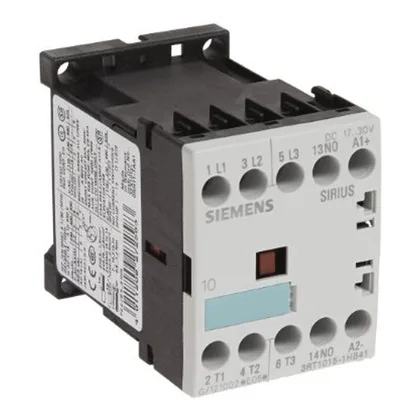
The 24 V DC coil pulls 2.3 W to close and holds at the same 2.3 W, with a built-in diode for surge suppression, so you don't need an external snubber across the coil.
The headline AC-3 rating at 400 V is 10 A — that's the motor-switching current this contactor handles reliably for standard squirrel-cage induction motors up to 4.5 kW at 500 V or 5.5 kW at 690 V. For resistive loads (AC-1), the maximum operating current is also 10 A. If you're switching motor loads at 400 V under AC-4 duty (plugging, inching), the rating drops to 8.5 A — the arc wears the contacts faster, so you need the lower figure for repetitive reversing. The 30 million mechanical cycles typical lifespan means this contactor outlasts most machines in the panel.
Coil and Wiring Details
Coil operates on 24 V DC nominal. The integrated diode suppresses the inductive kick when the coil de-energizes — that's standard for DC coils, but it means polarity matters: wire the positive to the A1 terminal. Screw terminals on the main circuit accept two conductors per clamp, from 0.5 mm² up to 4 mm², or AWG 20 to 14 with a single 12 AWG allowed. The auxiliary contact block adds one N.O. instantaneous contact, which is handy for feedback to a PLC input.
Environmental and Coordination
For short-circuit coordination: a Type 1 install needs a 35 A gL/gG fuse upstream; Type 2 requires a 20 A gL/gG fuse.