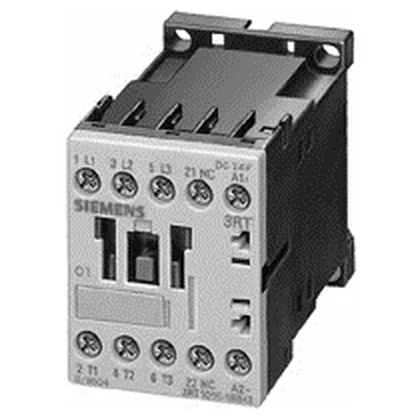
The coil is rated 110 V DC, with a closing and holding power of 2.3 W — a steady-state draw that stays within the typical 24 V DC supply budget for a small panel section. A varistor surge suppressor is built into the coil circuit, so you don't need an external snubber for DC switching transients.
At 230 V rated value the contactor carries 6 A in AC-1 duty (resistive load). That's the thermal current for heater banks or lighting contactor applications where inrush is low. The contactor also carries 10 A at AC-12 (control-circuit duty, 24 V), 2 A at 60 V DC, 1 A at 110 V DC, and 0.3 A at 220 V DC. The DC switching capability is derated by voltage — the 110 V DC 1 A rating is the one that matches the coil voltage for auxiliary switching in the same panel.
Coordination and wiring
For Type 1 coordination (welding allowed but no fire hazard) the fuse can be 35 A gL/gG. These values govern the short-circuit protection rating of the branch circuit. Main circuit terminals accept screw-type connections: 2x (0.5 to 1.5 mm²), 2x (0.75 to 2.5 mm²), or max 2x (0.75 to 4 mm²) solid or stranded. AWG equivalents are 2x (20 to 16), 2x (18 to 14), or 1x 12. The contactor has one instantaneous auxiliary contact (1 NO/NC configurable).
If you are evaluating a BOM freeze or a second-source gate, the closest functional peer in the SIRUS S00 family is the 3RT1016-1AR11 (same frame, same AC ratings, but with an AC coil instead of DC). The DC-coil variant (this one) is preferred for applications where the control voltage is already 110 V DC and you want the built-in varistor suppression without adding an external diode.