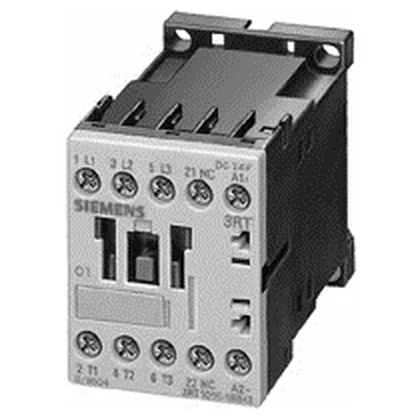
The DC coil is rated at 24 V and pulls a constant 1.4 W whether closing or holding, which simplifies the power supply sizing. An integrated diode handles surge suppression right on the coil, so you don't need to add an external flyback diode across the coil terminals.
Ratings that matter for the motor circuit
For AC-3 duty — the standard for squirrel-cage motor starting — this contactor is rated to switch 4.5 kW at 500 V and 5.5 kW at 690 V. That's the number that decides whether it handles your motor load without welding contacts. The auxiliary contact ratings are given at several voltage levels: 10 A at 24 V, 6 A at 230 V, and 3 A at 400 V. That covers pilot duty for PLC inputs or relay coils downstream. With Type of Coordination 2, the recommended fuse is a gL/gG 20 A; for Type 1 coordination, a 35 A fuse is specified. That keeps the contactor from welding under a short-circuit fault when the upstream breaker clears it.
Mechanical fit and environment
The contactor body is 45 mm wide, 57.5 mm tall, and 72 mm deep — a compact footprint that fits tightly on a 35 mm DIN rail. The enclosure carries IP20 on the front and at the terminals — that's finger-safe but not sealed, so it belongs inside a panel, not out in a washdown zone. Wire sizes accepted: solid or stranded from 0.5 to 4 mm² on the main contacts, with AWG equivalents of 2x (20–16), 2x (18–14), or 1x 12. That handles standard motor leads up to about 4–5.5 kW.