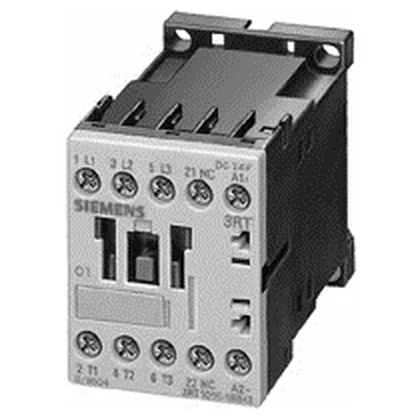
The coil is rated 24 V at both 50 Hz and 60 Hz, with an operating range of 0.8...1.1 × rated voltage at 50 Hz and 0.85...1.1 at 60 Hz, so it holds in across typical line dips but drops out cleanly below the undervoltage threshold. Main contacts are spring-loaded terminals accepting 2× (0.25...2.5 mm²) solid or stranded wire (2× 24...14 AWG), which simplifies panel wiring without needing a separate terminal block for the power circuit.
AC-12 rating at 10 A covers resistive loads like heaters or lighting contactor duty. AC-2 at 400 V delivers 4 kW for slip-ring motor switching. AC-4 at 400 V is rated 8.5 A for reversing or inching duty on squirrel-cage motors — the most demanding switching category, so this contactor handles frequent starts and stops without derating. For DC switching, the contactor is rated 10 A at 24 V, 2 A at 60 V, 1 A at 110 V, and 0.3 A at 220 V — useful for DC brake coils or control transformers in mixed-voltage panels. Motor power ratings at 400 V AC-3 (standard starting) are not explicitly listed in this spec set, but the AC-2 and AC-4 figures give a practical envelope: expect around 4 kW for general-purpose motor starting, with coordination type 1 requiring a 35 A gL/gG fuse and type 2 requiring 20 A.
The contactor measures 45 mm wide × 60 mm high × 73 mm deep, fitting a standard DIN-rail footprint.