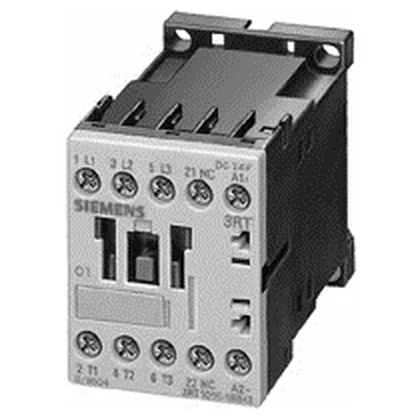
The 24 VAC coil accepts both 50 Hz and 60 Hz supplies, with an operating range of 0.8 to 1.1 times the rated voltage at 50 Hz and 0.85 to 1.1 at 60 Hz.
The headline motor ratings tell you what this contactor can handle in real duty cycles. At 400 V AC-2 (starting and running slip-ring motors), it's rated for 4 kW. For AC-4 duty (plugging and inching — the tough one on contacts), it carries 8.5 A at 400 V. If you're switching a standard squirrel-cage motor at 500 V, it's good for 4.5 kW; at 690 V, that climbs to 5.5 kW. The DC switching ratings are 10 A at 24 V, 2 A at 60 V, 1 A at 110 V, and 0.3 A at 220 V — useful for pilot-duty or brake circuits.
Termination, coordination, and environment
Main current circuit uses spring-loaded terminals accepting 2x (0.25 to 2.5 mm²) solid or stranded wire, or 2x (24 to 14 AWG). The contactor is rated for pollution degree 3 (industrial environment), operates from -25 to +60 °C, and is good up to 2,000 m altitude without derating.