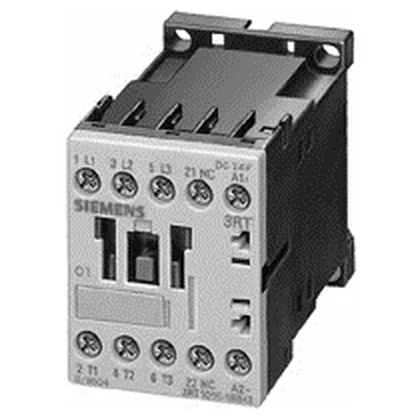
Main circuit connections use spring-loaded terminals accepting 2x (0.25 to 2.5 mm²) solid or stranded wire, or 2x (24 to 14 AWG). This speeds wiring in high-volume panel builds — no torquing required, just strip and push. Depth is 73 mm, height 60 mm.
Rated motor power is 4.5 kW at 500 V and 5.5 kW at 690 V in AC-3 duty (standard squirrel-cage motors). At 400 V AC-2 (slip-ring motors, moderate overload), it handles 4 kW. The AC-4 rating — for reversing or inching — is 8.5 A at 400 V, which is the limiting factor for high-cycle jogging applications. One instantaneous auxiliary contact is built in, rated 10 A at 24 V, 6 A at 230 V, and 3 A at 400 V AC. That covers feedback to a PLC or holding-circuit interlock. For DC switching: 10 A at 24 V, 2 A at 60 V, 1 A at 110 V, 0.3 A at 220 V. Short-circuit coordination: with Type 1 coordination, use a 35 A gL/gG fuse; with Type 2 (limited damage), a 20 A gL/gG fuse. The operating voltage range factor is 0.85 to 1.1 at 50 Hz, 0.8 to 1.1 at 60 Hz — meaning coil pickup is reliable down to 85% of nominal at 50 Hz. Mechanical endurance is 30 million operating cycles typical.