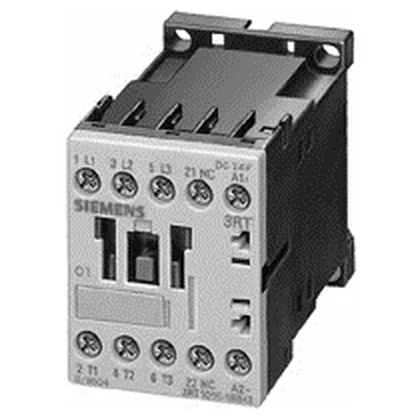
Rated for AC-2 duty at 4 kW and AC-4 at 8.5 A, both at 400 V, this contactor handles slip-ring motor starting and plugging/reversing applications. The AC-2 figure governs the real-world motor load it can switch under normal starting conditions — that 4 kW is the number to match against your motor nameplate. Spring-loaded terminals on the main circuit accept 2x (0.25 to 2.5 mm²) solid or stranded wire, or 2x (24 to 14 AWG). No screwdriver torque to worry about — strip, push, done. That saves time on a panel build.
Auxiliary contact ratings and coil options
The built-in auxiliary contact block carries a 24 V rated current of 10 A, dropping to 2 A at 60 V, 1 A at 110 V, 0.3 A at 220 V, 6 A at 230 V, and 3 A at 400 V. That voltage-dependent curve means the same contact handles signal-level loads at higher voltages — useful when mixing control and indication circuits on the same contactor. Coil operates at 50 or 60 Hz with a tolerance of 0.85 to 1.1 times the rated voltage. The 200 V rated value at 50 Hz and 200–220 V at 60 Hz means it works across common European and North American control voltages without a separate transformer tap.
Fuse coordination is straightforward: type 2 coordination calls for a 20 A gL/gG fuse; type 1 allows a 35 A gL/gG. That's the same as other S00 contactors in the family, so your existing panel design's fuse selection carries over.
Altitude limit is 2,000 m, which covers most installations outside high-mountain sites. Typical for a control panel in a factory floor setting.