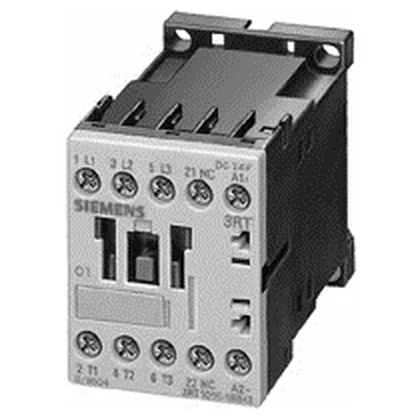
It carries an AC-4 switching current of 8.5 A at 400 V, meaning it handles the demanding inching and plugging duty cycles that stress standard contactors. For continuous motor duty, it delivers 4.5 kW at 500 V and 5.5 kW at 690 V, covering a range of European and North American line voltages. The main circuit uses spring-loaded terminals accepting 2x (0.25 to 2.5 mm²) solid or stranded wire, which speeds panel wiring and eliminates the need for periodic screw-torque checks.
Where it fits — panel integration and environment
The contactor occupies a 45 mm wide by 60 mm tall footprint with a depth of 73 mm, sized for dense DIN-rail packing. Side-by-side mounting is permitted, which keeps multi-contactor motor starter groups compact.
For Type 2 coordination (contactor remains operational after a fault), the fuse drops to gL/gG 20 A. These values define the maximum fuse size for the respective coordination class — oversizing the fuse risks welding the contacts or damaging the enclosure on a fault. If your motor draws more than 8.5 A during inching, step up to the next SIRIUS frame size. For straight AC-3 starting duty, the contactor's thermal current (not explicitly listed here) typically exceeds the AC-4 figure, but the AC-4 number is the one that governs for high-stress cycles.