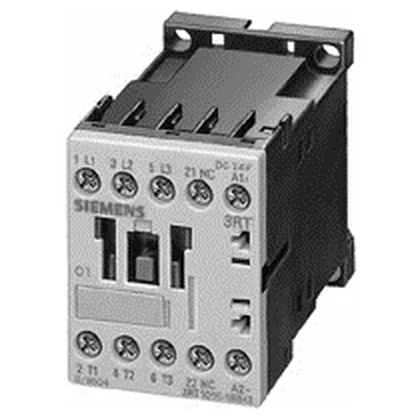
The spring-loaded terminals on the main circuit accept 2x (0.25 to 2.5 mm²) solid or stranded wire, so no screw torque check is needed on the power connections — just strip to 8 mm and push in. For motor duty, the AC-3 rating at 400 V delivers 4 kW, and at 500 V it handles 4.5 kW, climbing to 5.5 kW at 690 V. That means this contactor is sized for a 4.5 kW, 500 V three-phase motor on a conveyor or pump — the 690 V rating gives headroom for 480 V or 575 V line supplies common in North American panels. Auxiliary contact switching capacity spans from 10 A at 24 V down to 0.3 A at 220 V DC, which covers PLC input signals and relay coil control without an interposing relay in most cases.
At 45 mm wide, 60 mm tall, and 73 mm deep, the S00 frame tucks into tight DIN-rail rows. The IP20 finger-safe enclosure on the front and terminals means it's safe for open-panel installation behind a locked door; no additional shrouding is required for touch protection. For installations above 2,000 m altitude, derating applies; below that, the ratings hold as stated.
Protection and coordination
This matters for the panel designer: if you need to maintain the contactor through a fault, size the branch fuse at 20 A; if you accept a swap-out after a fault, you can go to 35 A for higher fault-clearing capacity. The auxiliary contact block is a single instantaneous N.O. or N.C. contact, configurable on the front. For multi-signal feedback or PLC interlocks, you'll need to add a side-mount auxiliary block — the base unit carries one contact only.