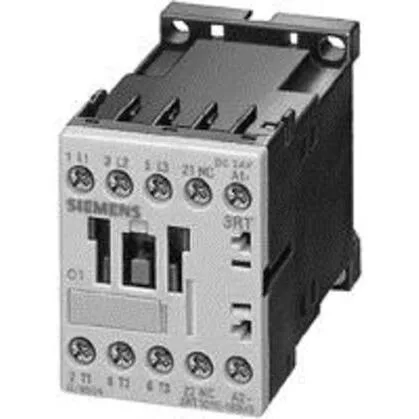
Main contacts are spring-loaded terminals, accepting 2x (0.25... 2.5 mm²) solid or stranded wire — no screw torque to verify, which speeds wiring on a line-down swap. The front and terminal faces carry IP20 finger protection, standard for enclosed panel gear.
In AC-3 duty (squirrel-cage motors, start/run), this contactor is rated 4.5 kW at 500 V and 5.5 kW at 690 V — that's the load it can switch under typical starting inrush without welding contacts. For AC-4 (plugging, inching, reversing), the rating drops to 8.5 A at 400 V, reflecting the higher electrical wear from breaking stalled-rotor current. The AC-2 rating (slip-ring motors, wound-rotor) is 4 kW at 400 V. The auxiliary contact ratings cover 24 VDC at 10 A down to 220 VDC at 0.3 A — useful for interlocking or PLC-level signals. Mechanical endurance is 30 million cycles — a number that matters for high-cycle applications like conveyor sorters or packaging machines.
Width is 45 mm, height 60 mm, depth 73 mm — the compact S00 footprint fits standard 35 mm DIN rail. Side-by-side mounting is allowed (no derating gap needed), so you can pack multiple contactors in a row without losing panel space. The 6 mm clearance to adjacent components on the side is the minimum for heat dissipation. Spring-loaded terminals accept 2x (0.25... 2.5 mm²) or 2x (24... 14 AWG) conductors. Strip length is not listed here, but standard practice for this terminal type is 8–10 mm.
For Type 2 coordination (contactor remains usable after a fault), the fuse drops to gL/gG 20 A. These values guide the upstream protection selection for a given motor branch.