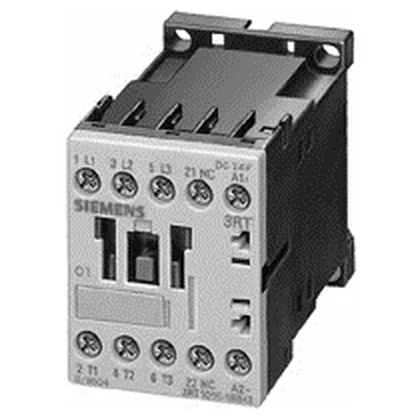
The Siemens 3RT1016-2BG42 is a SIRIUS power contactor in the compact S00 frame, rated 4 kW in AC-2 duty at 400 V — meaning it handles moderate motor loads like conveyors or pumps where the switching frequency isn't extreme but the inrush needs controlled make-and-break. AC-2 covers slip-ring motor starting and plugging duty, so this contactor is sized for applications where the load current stays within the rated motor power curve, not just resistive heating. The S00 frame is Siemens' smallest contactor chassis, 45 mm wide, 60 mm tall, and 73 mm deep — a tight footprint that stacks well on a 35 mm DIN rail per EN 50022.
Main power circuit connections use spring-loaded terminals, accepting 2x (0.25 to 2.5 mm²) solid or stranded wire, or 2x (24 to 14 AWG). Spring-cage termination speeds up panel wiring compared to screw clamps — no torque driver needed, just strip 8–10 mm and push in. The IP20 finger-safe protection on the front and terminals means the contactor can sit exposed in a control cabinet without additional shrouding for routine touch-safety.
Ratings and load handling
Beyond the AC-2 motor rating, this contactor carries an AC-4 rating of 8.5 A at 400 V — that's the reversing and inching duty cycle, where the contactor makes and breaks stalled rotor current. AC-4 is the tougher thermal test; the 8.5 A figure tells you the contactor can handle frequent reversals on a motor up to roughly 4 kW, but the thermal capacity is set by the AC-4 current, not the motor nameplate. For AC-12 resistive loads, the maximum operating current is 10 A. Motor power ratings extend to 4.5 kW at 500 V and 5.5 kW at 690 V, so the contactor covers 400 V to 690 V line supplies without derating the motor power — useful on 690 V mining or industrial networks. The coil is a DC-operated type with 3.3 W closing and holding power, meaning the coil driver sees a constant DC load with no AC hum.
Installation environment and protection
The mechanical endurance is 30 million switching cycles, which outlasts most electrical life ratings; the actual service life will be limited by the load current and switching frequency.
Short-circuit coordination
For Type 1 coordination, a gL/gG fuse rated 35 A clears a fault without destroying the contactor; for Type 2 coordination, a 20 A fuse limits damage to the contactor so it remains functional after a short circuit. This matters when designing a motor branch circuit to IEC 60947-4-1 — the fuse size determines the let-through energy the contactor must survive.