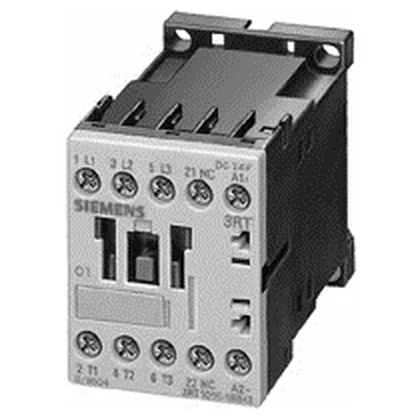
The main current circuit uses spring-loaded terminals, accepting 2x (0.25 to 2.5 mm²) solid or stranded conductors — no screw torque to verify, which saves time on the wireman's side.
The coil closing and holding power are both 2.3 W DC, so the control transformer or DC supply needs to budget that draw continuously. For motor duty: AC-2 at 400 V is rated 4 kW, and AC-4 at 400 V is 8.5 A. AC-2 covers slip-ring motors; AC-4 covers plugging and inching. If your application is standard squirrel-cage starting (AC-3), the 3RT1016-2AP02 sibling is the one to cross-check — this unit's AC-4 figure tells you it handles reversing or jogging duty at that current. The auxiliary contact ratings: 10 A at 230 V (AC-12 resistive), 6 A at 230 V, 3 A at 400 V, 2 A at 60 V, 1 A at 110 V, 0.3 A at 220 V. That covers most signal-level switching in a 24 VDC or 230 VAC control circuit. Type 1 coordination requires a 35 A gL/gG fuse; Type 2 coordination needs a 20 A gL/gG fuse. If you're building to a specific SCCR target, the fuse choice drives the let-through energy — Type 2 is tighter on fault current. For high-cycle applications like conveyor diverters, that's a solid baseline.
The surge suppressor is built in with a diode (designed for DC coils), so there's no separate suppressor module to order and no free-wheeling diode to add externally. That's one less line item on the BOM. Front protection is IP20 — finger-safe from the front, but not sealed. It's a panel-mount part, so it expects enclosure protection; no washdown rating here.
Width 45 mm, height 60 mm, depth 73 mm. If you're replacing a 3RT1016-2AP02, the footprint is identical; the difference is the coil voltage and termination type.