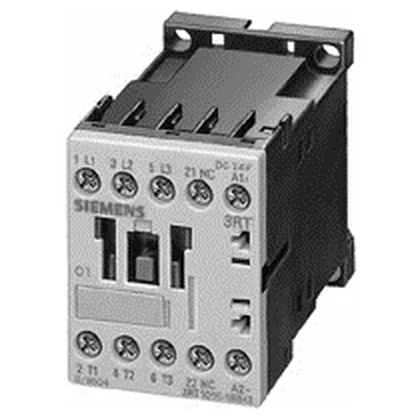
Siemens SIRIUS 3RT1016-2WB42 — S00 Power Contactor, 24 VDC Coil, Spring-Loaded
The Siemens SIRIUS 3RT1016-2WB42 is a size S00 power contactor with a 24 VDC coil, built for switching motor and resistive loads in control panels. It lands in the SIRIUS family, the workhorse line for standard industrial automation across 400 V and 690 V networks. Termination is via spring-loaded terminals on the main current circuit, accepting 2x (0.25 to 2.5 mm²) solid or stranded wire — no screw torque, no re-tightening during thermal cycling. Mounting is screw or snap-on onto 35 mm DIN rail per EN 50022, so it drops straight into a standard panel rail alongside other SIRIUS gear. The contactor carries an integrated varistor surge suppressor across the coil, meaning you don't need to add a separate RC snubber for DC switching — the coil's closing and holding power both sit at 1.4 W DC, a steady draw that keeps the control transformer sizing predictable.
What the Ratings Mean for Your Panel
The headline AC-12 rating of 10 A at 24 V tells you this contactor handles resistive and solid-state loads in control circuits — think PLC output isolation or heater contactors — up to that current. For motor duty, the AC-2 rating at 400 V is 4 kW, covering wound-rotor motors and moderate switching frequencies where the load isn't hammering the contacts on every cycle. The AC-4 rating at 400 V is 8.5 A — this is the plugging / inching duty class, where the contactor makes and breaks stalled-rotor current. If your application cycles the motor on and off under full load (conveyor jog, crane inching), this is the number that governs contact life, not the AC-12 figure. Mechanical life is typical 30 million operations — that's the bare contactor without load. Electrical life will be lower and depends on the switching category and current; the AC-4 rating is where you'll see the shortest contact endurance. The contactor is rated for pollution degree 3 (industrial environment, conductive dust or condensation possible) and IP20 on the front and terminals — finger-safe from the front, but not sealed against washdown. Operating temperature spans -25 to +60 °C, with a maximum altitude of 2,000 m before derating.
