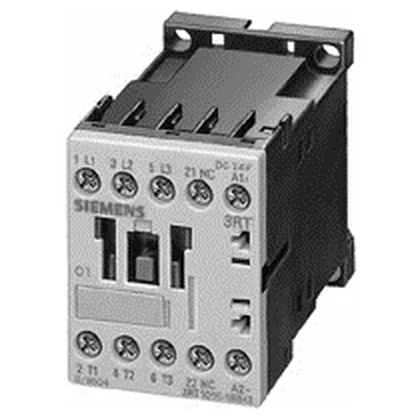
Its 24 VDC coil pulls in at 10 A rated operational current (AC-12), and it handles 5.5 kW motor power at 400 V. The screw-type terminals accept up to 4 mm² on the main circuit, and the front is IP20-protected.
The 10 A AC-12 rating governs resistive loads; for motor switching, the AC-3 rating at 400 V is 5.5 kW, which covers a standard 7.5 HP induction motor on a 400 V line. The AC-4 rating at 400 V is 8.5 A — that's the inching or plug-reverse duty cycle, so if your application does frequent reversing, size against that lower current, not the AC-3 number. The 24 VDC coil holds at nominal and drops out below about 18 V; verify your control supply doesn't sag under load. Coordination matters: with type 2 coordination (no weld risk on short circuit), the required upstream fuse is 20 A gL/gG. For type 1 coordination (allow contactor replacement after fault), it's 35 A gL/gG. If your panel spec calls for type 2, don't oversize the fuse — the contactor's withstand is tied to that 20 A limit.
Footprint is 45 mm wide, 57.5 mm tall, 72 mm deep — fits the standard S00 slot on a DIN rail. The screw terminals on both main and auxiliary circuits accept 2x (0.5 to 1.5 mm²), 2x (0.75 to 2.5 mm²), or max 2x (0.75 to 4 mm²) solid or stranded. For AWG, that's 2x (20 to 16), 2x (18 to 14), or 1x 12. Strip length is standard 8–10 mm for screw clamps.