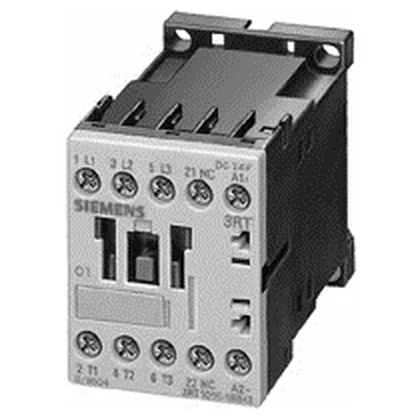
The S00 frame keeps the footprint tight at 45 mm wide, 57.5 mm tall, and 72 mm deep, so it packs into crowded DIN-rail enclosures without stealing space from the next device.
For a DC coil, the pick-up voltage is typically higher than the drop-out; this one holds in at 0.8 to 1.1 times rated voltage at 50 Hz and 0.85 to 1.1 at 60 Hz, so a saggy 24 VDC supply down to about 19.2 V still keeps it sealed. Below that, it drops out cleanly, which is the behaviour you want for a safety circuit. For motor duty, the AC-3 rating at 500 V is 5.5 kW — that's the standard induction motor switching capability. At 400 V AC-2 duty (slip-ring motors or high-inertia loads) it also delivers 5.5 kW. The AC-4 rating (plugging/reversing/inching) is 8.5 A at 400 V, which is about 3 kW on a 400 V motor — so if your application does frequent reversing, derate accordingly. Front protection is IP20 — finger-safe but not washdown-rated.
Coordination and wiring
That's the number your panel builder needs for the short-circuit protection device upstream. Main circuit terminals are screw-type, accepting 2x (0.5 to 1.5 mm²), 2x (0.75 to 2.5 mm²), or max 2x (0.75 to 4 mm²) solid or stranded conductors. AWG equivalents are 2x (20 to 16), 2x (18 to 14), and 1x 12. That covers most panel wiring up to 4 mm² without needing ferrule adapters. It carries one instantaneous auxiliary contact — that's the built-in mirror contact for feedback to the PLC or safety relay. If you need more auxiliary contacts, you add a side-mount block (SIRIUS 3RH series), which clips on without tools.
The 3RT1017-1AR01 is the DC-coil version; the AC-coil sibling (3RT1017-1AP01) shares the same mechanical footprint and ratings but uses a different coil voltage — so they're not electrically interchangeable without changing the control circuit supply.