What it is and what it does
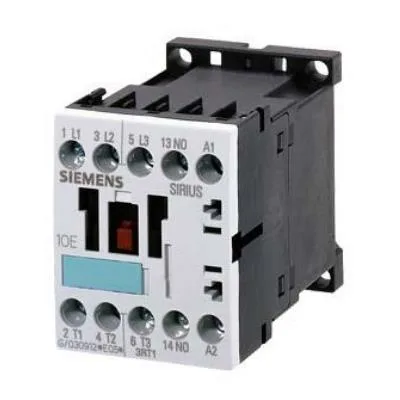
The Siemens 3RT1017-1BB41-0UA0 is a SIRIUS power contactor in the S00 frame size, designed for switching motor loads in industrial control panels. It's a 3-pole contactor with a 24 VDC coil, screw-type terminals for the main circuit, and an IP20 rated front for basic finger protection in enclosed assemblies. The key motor rating here is 5.5 kW at both 400 V and 690 V under AC-3 duty, which covers the majority of standard induction motor applications. For reversing or plugging duty, the AC-4 rating is 8.5 A at 400 V — that's the number to watch for high-inertia loads or frequent reversing cycles. The 24 VDC coil draws 3.3 W for both closing and holding, so it's a constant-power coil — no extra inrush to budget for in your DC supply sizing. The pickup voltage is 0.85 x rated (20.4 VDC) and dropout is 1.1 x rated (26.4 VDC), meaning it holds in during brownouts down to about 20 V.
Panel fit and wiring
This contactor snaps onto a 35 mm DIN rail per EN 50022 and occupies 45 mm of panel width. Depth is 72 mm, height 57.5 mm — it's a compact S00 footprint that leaves room for auxiliary contact blocks or a solid-state overload relay alongside. The screw terminals accept 2 x (0.5 to 1.5 mm²) or 2 x (0.75 to 2.5 mm²) solid/stranded, with a max of 2 x (0.75 to 4 mm²). For AWG, that's 2 x (20 to 16) or 2 x (18 to 14), plus a single 12 AWG. Side-by-side mounting is allowed with 6 mm clearance to adjacent devices — no derating required for the IP20 finger-safe front. Operating temperature range is -25 to +60 °C, with pollution degree 3 rated for industrial environments with conductive dust or condensation. Maximum operating altitude is 2,000 m without derating.
Lifecycle and sourcing
The reference code per DIN EN 81346-2 is Q, which maps to switching devices in a panel schematic. Compliance documentation (RoHS, REACH, CE, UL) is available from Siemens for this active part — standard for any SIRIUS contactor shipped into EU or North American markets.
Auxiliary contacts and coordination
One instantaneous auxiliary contact is built in (1 NO/NC configurable). Its switching capacity at 24 V is 10 A, dropping to 2 A at 60 V, 1 A at 110 V, and 0.3 A at 220 V — typical for a standard auxiliary block. For Type 1 coordination, use a 35 A gL/gG fuse; for Type 2, a 20 A gL/gG fuse protects the contactor against weld-on faults. Mechanical life is rated at 30 million operations typical — that's the figure for the contactor mechanism itself, not the electrical endurance under load. Electrical life depends on the switching category and current, but the mechanical rating gives a ceiling for high-cycle applications like conveyor indexing or packaging machinery.
