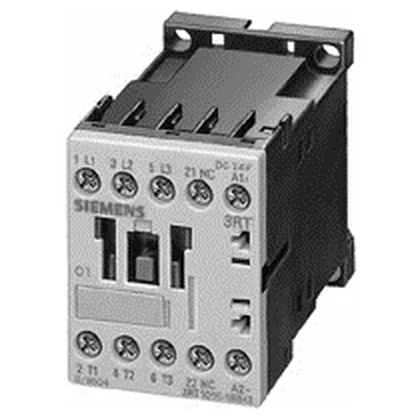
What it is and what it does
The Siemens SIRIUS 3RT1017-1MB42-0KT0 is a size S00 power contactor with a 24 VDC coil, designed for switching motor loads and resistive loads in control panels. It mounts via screw or snap-on onto 35 mm DIN rail per DIN EN 50022, and its 45 mm width fits standard panel layouts with 6 mm side clearance for heat dissipation. Rated at 5.5 kW at 400 V AC-3, it handles typical three-phase motor starting duty. The AC-4 rating of 8.5 A at 400 V covers reversing or inching applications where the contactor makes and breaks stalled rotor current. Mechanical life is rated at 30 million operating cycles, which for a size S00 frame is a solid figure for high-cycle conveyor or pump stations.
Coil and control circuit
The 24 VDC coil draws 1.4 W during both closing and holding, so the inrush is the same as the sealed power — no extra surge on the DC supply. Pickup and dropout voltages follow the standard IEC 60947-4-1 envelope; the coil holds at nominal and drops out reliably below the release threshold. For a 24 VDC bus, this contactor pairs cleanly with a PLC digital output or a solid-state relay without needing a separate coil suppression network, though a free-wheel diode across the coil is still good practice if the driving output lacks one.
Termination and wiring
Main circuit terminals are screw-type, accepting 2x (0.5 to 1.5 mm²), 2x (0.75 to 2.5 mm²), or up to 2x (0.75 to 4 mm²) solid or stranded copper. AWG equivalents are 2x (20 to 16), 2x (18 to 14), or 1x 12. The IP20 finger-safe terminal shrouds are standard for panel-mount gear — no special tooling needed beyond a common screwdriver. Side-by-side mounting is permitted, so you can gang multiple contactors on the same DIN rail without derating, as long as ambient stays within -25 to +60 °C.
Short-circuit coordination
For Type 1 coordination (no damage to the contactor but may need contact replacement), the maximum fuse is 35 A gL/gG. For Type 2 coordination (contactor remains fully functional after a fault), the limit is 20 A gL/gG. Pollution degree 3 rating means it's suited for industrial environments with conductive dust or occasional condensation — typical for a non-sealed panel.
