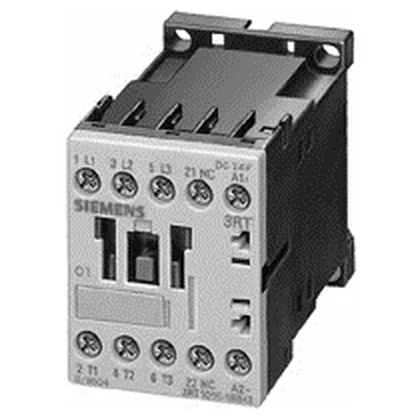
For more demanding AC-4 duty — plugging, inching, or reversing a squirrel-cage motor at full stall current — the contactor is rated 8.5 A at 400 V. At higher line voltages the contactor delivers 5.5 kW at both 500 V and 690 V, which covers 480 V and 600 V class systems common in North American and some export panels. For DC switching — solenoid or brake loads — the contactor handles 10 A at 24 V, 2 A at 60 V, 1 A at 110 V, and 0.3 A at 220 V.
Main circuit terminals are spring-loaded (cage-clamp type), accepting 2x (0.25 to 2.5 mm²) solid or stranded, or 2x (24 to 14 AWG). No screw torque to verify — strip to 8 mm and push in. That 20 A Type 2 limit is the one to spec if you want to avoid replacing the contactor after a downstream fault.
Mechanical service life is 30 million operating cycles, which for a contactor that cycles once per minute translates to roughly 57 years — not the limiting factor in most panels.