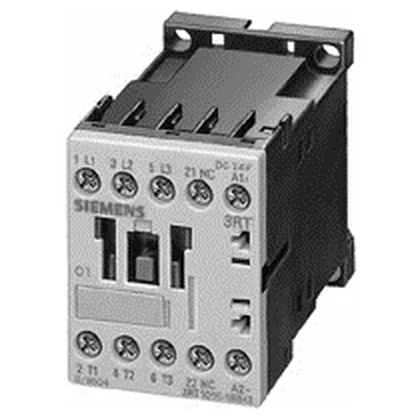
The main current circuit uses spring-loaded terminals accepting 2x (0.25 to 2.5 mm²) solid or stranded wire, or 2x (24 to 14 AWG). This termination style reduces wiring time versus screw clamps and holds reliably under vibration.
For AC-4 duty at 400 V — the category for reversing or inching motor starts — the contactor is rated 8.5 A. That is the switching current that governs contact life under frequent plugging or jogging; a higher AC-3 rating would apply for normal running starts, but AC-4 is the limiting case for applications with high electrical wear. Motor power ratings are 5.5 kW at 400 V (AC-2) and 5.5 kW at 690 V (AC-1 or similar resistive/motor duty). The 690 V rating confirms suitability for 690 V line supplies common in European industrial installations. DC switching capability is specified per voltage: 10 A at 24 V, 2 A at 60 V, 1 A at 110 V, and 0.3 A at 220 V. These are the make/break currents for DC loads; the inductive time constant of the circuit will affect actual performance, but these figures give a direct selection baseline for DC coil or auxiliary circuits.
Integration notes
Dimensions are 45 mm wide, 60 mm high, and 73 mm deep. The 73 mm depth includes the spring-loaded terminal projection; verify clearance behind the DIN rail for wiring loops, especially with 2.5 mm² conductors. For type 1 coordination (allow contactor replacement after fault), use gL/gG 35 A. These fuse ratings apply per IEC 60947-4-1 and should match the branch circuit protection design.